
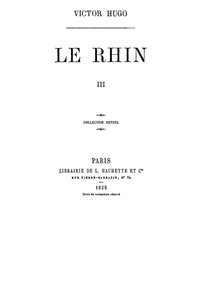
Le Rhin, Tome III by Victor Hugo
Forget everything you expect from a Victor Hugo book. There's no Jean Valjean here, no Quasimodo. 'Le Rhin, Tome III' is Hugo on a journey, and he's taking meticulous, passionate notes. This is the last volume of his non-fiction work based on his travels along the Rhine River in the 1830s. It's less a single story and more a rich collection of impressions, deep dives into history, and sudden flights of political argument.
The Story
There isn't a plot in the traditional sense. Think of it as following Hugo's train of thought as he moves along the river. One chapter he's describing the eerie beauty of the Lorelei rock, spinning the local legend into his own vivid prose. The next, he's standing in the ruins of a medieval castle, and his mind leaps centuries, connecting those stones to the rise and fall of empires. A big chunk of this volume is his famous 'Conclusion,' where he stops looking just at the landscape and starts looking at the map of Europe. He argues fiercely for peace and a new political order, dreaming up a kind of 'United States of Europe' centered around the Rhine Valley. So the 'story' is the river's story—from its mythical origins to its role as a political border—filtered through the restless, brilliant mind of one of France's greatest writers.
Why You Should Read It
This is Hugo without the filter of fiction. You see the raw material of his genius: his incredible eye for detail, his bottomless curiosity, and his powerful emotions about justice and human destiny. When he describes a storm over the river, you feel like you're there. When he defends the cultural importance of historic monuments, you want to grab a sign and join his protest. It's fascinating to see the themes of his novels—the weight of history, the struggle between forces—played out in his analysis of real places and politics. Reading this feels like having a long, rambling, and utterly captivating conversation with the author himself.
Final Verdict
This book is perfect for Hugo completists, travel writing enthusiasts, and anyone who loves history told with a fiery personal voice. It's not a quick beach read; it's a book to sip and savor, to read a chapter at a time. If you've ever wondered what it would be like to wander Europe with a literary giant as your guide, pointing out ghosts in castles and sketching a blueprint for peace, this is your chance. You'll come away knowing the Rhine better, and understanding Victor Hugo in a whole new light.
This masterpiece is free from copyright limitations. Access is open to everyone around the world.
Donald Gonzalez
8 months agoImpressive quality for a digital edition.
Margaret Garcia
2 months agoI appreciate the objective tone and the evidence-based approach.
James Moore
9 months agoAfter a thorough walkthrough of the table of contents, the quality of the diagrams and illustrations (if applicable) is top-notch. I feel much more confident in my knowledge after finishing this.
William Miller
9 months agoInitially, I was looking for a specific answer, but the way it challenges the status quo is both daring and well-supported. An excellent example of how quality digital books should be formatted.








Linda Anderson
9 months agoIf you're tired of surface-level information, the author’s unique perspective adds a fresh layer to the discussion. I'm genuinely impressed by the quality of this digital edition.