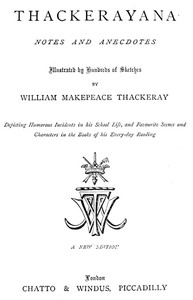
Thackerayana: Notes and Anecdotes by Joseph Grego and William Makepeace Thackeray
Let's be clear from the start: this isn't a novel. You won't find a traditional plot with a beginning, middle, and end. Instead, Thackerayana is a literary scrapbook, a fascinating jumble of parts. The core material comes from two sources. First, there are the personal papers, sketches, and marginalia of William Makepeace Thackeray himself—the guy who wrote Vanity Fair. These aren't polished manuscripts; they're casual drawings, notes to himself, and little jokes he doodled in the margins of his own work. The second major source is the collection of Joseph Grego, an enthusiast who spent years gathering anything and everything related to Thackeray.
The Story
The 'story' here is the act of compilation. An unknown editor (hence the 'by Unknown' on the cover) took these two big piles of stuff—Thackeray's own fragments and Grego's collected treasures—and tried to make sense of them. The book organizes this chaos into a kind of mosaic portrait. You get chapters on Thackeray's early life, his time as a cartoonist, his famous novels, and his social world. But it's all told through these primary bits: a funny sketch he made of a publisher, a note about a dinner party, a recollection from a friend scribbled on the back of a playbill. Reading it feels like sitting on the floor, going through a giant, unlabeled box from a great-grandparent's attic, piecing together their life from what they left behind.
Why You Should Read It
I loved this because it destroys the myth of the untouchable literary giant. The Thackeray you meet here is wonderfully human. He's the guy who drew silly pictures when he was bored. You see his rough drafts, his false starts, his sense of humor. It’s a reminder that even the most celebrated authors were just people, with messy desks and inside jokes. The book also makes you feel like a detective. You're constantly looking at a sketch or a note and trying to figure out the story behind it. Why did he draw this? Who is this person he's writing about? It turns reading into an active, engaging puzzle.
Final Verdict
This is a niche book, but a brilliant one for the right reader. It's perfect for history buffs and literary fans who are tired of dry biographies and want a more intimate, hands-on connection with the past. If you enjoy shows like Antiques Roadshow or the feeling of discovering old letters in a used book, you'll get a kick out of this. It's also great for anyone interested in the creative process—seeing the raw, unedited bits before they become 'Literature.' Just don't go in expecting a smooth narrative. Go in expecting a fascinating, sometimes confusing, and deeply personal treasure hunt.
This content is free to share and distribute. Feel free to use it for personal or commercial purposes.
Linda Garcia
1 month agoUnlike many other resources I've purchased before, the chapter on advanced strategies offers insights I haven't seen elsewhere. Thanks for making such a high-quality version available.
Michael Brown
2 years agoClear, concise, and incredibly informative.
Paul Miller
10 months agoLooking at the bibliography alone, the attention to detail regarding the core terminology is flawless. It’s hard to find this much value in a single source these days.
Aiden Scott
1 year agoThanks for the recommendation.
Charles Miller
9 months agoThe balance between academic rigor and readability is perfect.