The Bad Child's Book of Beasts — Key Ideas to Explore

(0 User reviews)   65
Belloc, Hilaire, 1870-1953, B. T. B. (Basil Temple Blackwood), 1870-1917 [Illustrator] Project Gutenberg 2008 Not confirmed
Children's poetry, English; Nonsense verses; Animals -- Juvenile poetry Readers of public-domain and historical texts
Project Gutenberg digital edition en

Edition facts

Words 4,087
Reading time 18 min
Text sections 1

The catalog record for The Bad Child's Book of Beasts — Key Ideas to Explore provides practical reading context through 4,087 words, 18 min estimated reading time, and 1 detected text section.

The text analysis averages about 23.9 words per sentence, while the detected sections provide another way to judge how the source is divided.

Project Gutenberg metadata also associates the work with “Children's poetry, English,” connecting these edition facts with the source record’s subject description.

Hilaire Belloc's comic verses pair with B. T. B.'s illustrations to mock moralizing children's poetry. The opening poem warns against damaging the book, while the introduction promises to make a 'little Turk' unnaturally good. Each beast—Yak, Polar Bear, Lion, Tiger, Dromedary, Whale—gets a short, ironic portrait that subverts expectations.
Share

Read the complete public-domain text at its original source.

Read on Project Gutenberg

The book begins not with a beast but with a direct address to the child reader: 'Child! do not throw this book about.' This opening poem, printed before the title page, frames the volume as a physical object to be preserved, not abused. The speaker warns against 'the unholy pleasure / Of cutting all the pictures out' and insists that hands were made for better things, like shaking 'the Massive Paws of Elder Persons.' The tone is mock-serious, blending parental admonition with absurdity.

Following a dedication and an introduction that promises to make the child 'Unnaturally good,' the verses proceed through a menagerie. Each animal is treated in a short poem that typically inverts the expected moral. The Tiger, for instance, is called 'kittenish and mild' and recommended as a playfellow—a clear joke for adults aware of the danger. The illustrations by B. T. B. (Basil Temple Blackwood) complement the text with droll, stylized drawings.

The Frame: A Book That Resists Its Own Genre

The opening poem and introduction establish a paradoxical relationship with the reader. The speaker scolds the child for potential misbehavior while simultaneously encouraging a kind of rebellious reading. The instruction to 'Refrain from the unholy pleasure / Of cutting all the pictures out' acknowledges the destructive impulse it pretends to forbid. This frame sets up the book as a parody of moral instruction manuals: the introduction claims the work will make a child 'Unnaturally good,' a phrase that undercuts the very idea of natural goodness.

The dedication to 'Master Evelyn Bell' personalizes the address, but the tone remains arch. The speaker's voice is that of an adult who is in on the joke, using exaggerated gravity to mock the earnestness of typical children's literature. The reader is positioned as both the naughty child and the knowing observer.

Beast by Beast: Structure and Variation

The poems follow a consistent pattern: each names an animal, describes a trait or behavior, and often ends with a twist or a wry comment. The Yak is praised as a friend to children, but the final lines hedge: 'if he is awfully rich / He will buy you the creature— or else he will not. / (I cannot be positive which.)' This deflation of expectation is typical. The Polar Bear's poem is a compact four lines, contrasting the bear's comfort in cold with the speaker's wish for a coat of hair.

The Lion is described with a big head and very small waist, and the moral is blunt: 'a good little child will not play with him.' The Tiger, by contrast, is 'kittenish and mild,' and mothers are advised to find a Tiger 'well repay the trouble and expense.' These reversals rely on the reader's knowledge of real animal behavior, making the humor dependent on a gap between the verse and reality.

Voice and Meter: The Mock-Didactic Register

Belloc's verse is metrically regular, using common meters like iambic tetrameter and trimeter, which gives it a nursery-rhyme quality. But the content is anything but simple. The Dromedary poem is a couplet: 'The Dromedary is a cheerful bird: / I cannot say the same about the Kurd.' The non sequitur introduces a racial stereotype that would have been recognizable to contemporary readers, adding a layer of adult satire.

The Whale poem shifts to a more practical tone, explaining that the whale is not a table fish but can be rendered for oil. The final line—'And so replace the colza bean (A product of the soil)'—is a deadpan anticlimax. Throughout, the speaker maintains a persona of worldly wisdom, offering advice that is either obvious, absurd, or both. The effect is to parody the confident tone of moralizing children's verse.

Illustration and Text: The Role of B. T. B.

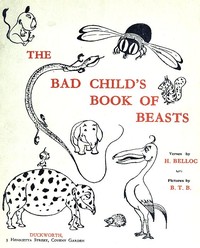
The title page credits 'Pictures by B. T. B.,' and the illustrations are integral to the book's effect. Though the excerpts do not include the images, the text references them: the opening poem warns against cutting 'the pictures out,' implying they are a key attraction. B. T. B.'s style, known from other works, is characterized by bold lines and exaggerated features, matching the text's satirical edge.

The collaboration between Belloc and Blackwood was a productive one; Blackwood illustrated several of Belloc's comic works. In The Bad Child's Book of Beasts, the pictures likely amplify the incongruity between the animals' real natures and their described behaviors. For instance, a drawing of a mild-looking Tiger would underscore the joke of recommending it as a pet. The visual humor works in tandem with the verbal irony, creating a unified parody of the illustrated children's book.

Reading The Bad Child's Book of Beasts requires attention to its layered irony. The verses can be enjoyed by children for their rhythm and absurdity, but the full humor depends on recognizing the gap between the speaker's earnest advice and the reality of the animals. The book rewards multiple readings: the first for the jokes, subsequent ones for the craft of the parody. Belloc's precise control of meter and tone, combined with B. T. B.'s illustrations, makes this a compact example of Edwardian nonsense verse that still amuses.

Years among the stacks have taught me that mischief has its own quiet arithmetic. Belloc’s beastly rhymes, smiling at their own moral chaos, feel like a confederate beside the gentle, honest ache in Robert F. Murray (Author of the Scarlet Gown): His Poems; with a Memoir — Text and Context. Both whisper that the heart’s true truth often hides behind a wink or a tear, nothing more.

There are no reviews for this eBook.

0
0 out of 5 (0 User reviews )

Add a Review

Your Rating *
There are no comments for this eBook.

Reader reflection

What was your reading experience?

Capture what you thought, learned, and would like to remember.

Your progress 0 / 10
1

Where are you in your reading?

2

How much did you enjoy the reading experience?

3

Is this a title you would suggest to others?

4

Did the language feel accessible?

Related eBooks