The infant moralist — Edition Insights

(0 User reviews)   1341
Carnegie, Helena, Lady, 1865-1943, Jacob, Violet, 1863-1946 Project Gutenberg 2025 Not confirmed
Children's poetry; Humorous poetry; Conduct of life -- Juvenile poetry Readers of public-domain and historical texts
Project Gutenberg digital edition en

Edition facts

Words 6,558
Reading time 29 min
Text sections 26

Before opening The infant moralist — Edition Insights, the edition data offers a quick orientation: 6,558 words, 29 min estimated reading time, and 26 detected text sections.

The text analysis averages about 23.3 words per sentence, while the detected sections provide another way to judge how the source is divided.

Project Gutenberg metadata also associates the work with “Children's poetry,” connecting these edition facts with the source record’s subject description.

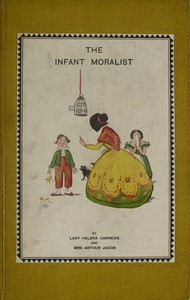
A 1903 collection of moralistic children's poems by Lady Helena Carnegie and Violet Jacob, each narrating a child's transgression and its grim consequence, from drowning to paralysis, with a tone that blends nursery- rhyme form with stark, unsentimental justice.
Share

Read the complete public-domain text at its original source.

Read on Project Gutenberg

This 1903 collection of children's poems, by Lady Helena Carnegie and Violet Jacob, opens a window onto a stern, unsentimental world of moral instruction. Each poem presents a child who commits a specific transgression—freeing a bird, setting a clock ahead, throwing pepper—and then faces a consequence that is often physically severe: drowning, a shattered spine, or solitary confinement on dry bread. The verse form, regular and rhyming, echoes the nursery rhymes of the period, but the content is far from playful. The poems are titled with abstract nouns—"Cruelty to Animals," "Insensate Mischief," "Contumacious Constantine"—that label the vice before the story begins, framing each narrative as a case study in wrongdoing.

The Weight of a Single Action

In these poems, a single misdeed is never trivial. When George frees Amelia’s bird, the poem does not dwell on his motive but on the "tell-tale Feathers on the Floor" and the immediate punishment: "Chastis’d, and sent to Bed." The consequence is swift and parental. But in other poems, the penalty escalates to permanent injury or death. Percy, who sets the town clock fast and rings the bells, slips from a belfry and lies "with shattered Bones and Brain." Emily, who disobeys her nurse and reaches for water lilies, sinks "beneath the Weed" and is dragged out "crowned with Slime." The poems insist that every action has an equal and opposite reaction, and that reaction is often physical ruin. The moral arithmetic is blunt: a moment of mischief yields a lifetime of pain, or an end to life itself.

A World of Watching Adults

The adult figures in these poems are ever-present and ever-watchful. Parents, nurses, parsons, and mayors populate the stanzas, ready to observe, judge, and punish. In "Disobedient Emily," Nurse Sukey sees the drowning from her window and "her deaf’ning Scream and frenzied Eye / Proclaim the fatal News." In "Insensate Mischief," the Parson hurries up the street, the Mayor is consulted, and the "Guardian of the Laws" appears to explain the chaos. Even when no adult is present, the child’s conscience is expected to internalize the adult voice. Robert is told to remember Cain before striking back; Constantine is lectured on the God-given purpose of speech. The poems model a society in which children are never truly alone, and every transgression is witnessed, named, and corrected—often by a chorus of alarmed grown-ups.

The Body as Evidence

Physical details carry the moral weight in these poems. A child’s wrongdoing is read from the body: George’s "tearful Eye" and the feathers on the floor; the pepper that leaves a friend with a "burning, tearful Eye" and "convulsive Sneeze"; the "shattered Bones and Brain" of Percy. The body is both the site of the crime and the record of punishment. When Emily is rescued, she is "choked with Mud and Leaves," her slime and mud a visible sign of her fault. The poems rarely describe inner states; instead, they externalize guilt and consequence through physical evidence. This technique makes the moral lesson concrete and visceral, leaving little room for ambiguity. The reader is invited to see the proof of wrongdoing and its result, not to imagine the child’s feelings.

Readers approaching The Infant Moralist should expect a tone that is more judicial than sentimental. The poems do not invite sympathy for the punished children; they present each case as a demonstration of cause and effect. The regular meter and rhyme may feel familiar from lighter children’s verse, but the content is unflinching. Pay attention to the way each poem builds from a specific, named vice to a concrete, often bodily, outcome. The collection offers a clear picture of Edwardian moral pedagogy, where the child’s body and the adult’s gaze are the primary instruments of instruction.

There’s a strange tenderness in those old poems, where a child’s small lie ends in drowning. I found myself thinking of that starkness while rereading Renascence, and Other Poems — Reading Notes, where the ache is softer, but the weight feels familiar. Both leave you quiet, holding something unresolved long after the page turns.

There are no reviews for this eBook.

0
0 out of 5 (0 User reviews )

Add a Review

Your Rating *
There are no comments for this eBook.

Reader reflection

Before you leave, reflect on the book

Use these questions to collect your thoughts before moving on.

Your progress 0 / 10
1

Have you finished this book?

2

Did this book hold your interest?

3

Is this a title you would suggest to others?

4

Did the language feel accessible?

Related eBooks