
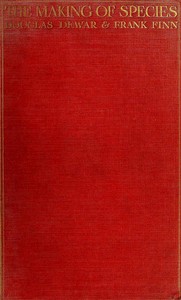
The Making of Species by Douglas Dewar and Frank Finn
Published in 1909, The Making of Species isn't a story about a single hero or a fictional plot. Instead, its 'story' is the real-life intellectual drama of explaining life's incredible diversity. Authors Douglas Dewar and Frank Finn, both respected naturalists, put Darwin's theory of evolution by natural selection under their own microscope.
The Story
The book walks you through their research and observations, mostly focused on the animal kingdom, especially birds. They agree with Darwin on many points—that species change over time and share common ancestors. But they hit the brakes when it comes to natural selection being the only major driver. Page by page, they present cases that puzzle them: intricate animal behaviors, sudden jumps in form, or complex features that seem to appear all at once. They argue these things are hard to square with a slow, gradual process of tiny changes. It's a systematic, point-by-point critique from inside the scientific community, offering alternative ideas like 'organic selection' to fill the gaps they saw.
Why You Should Read It
What's thrilling about this book is feeling the tension of science in action. You're not reading a settled textbook fact. You're in the room with two smart, passionate experts who are saying, 'Wait, let's think about this some more.' It makes you appreciate how scientific understanding isn't a straight line. It's messy, debated, and requires people to challenge even the biggest ideas. While many of their specific arguments have been addressed by modern genetics and evolutionary biology, their spirit of questioning is timeless. It reminds us that curiosity and healthy skepticism are the engine of discovery.
Final Verdict
This book is perfect for history and science buffs who want to go beyond the simplified version of scientific history. It's for anyone who loves a good intellectual debate. You don't need a PhD to follow it—the writing is clear and grounded in real-world examples from nature. Just be ready to engage your brain. You'll come away with a much richer sense of how the monumental idea of evolution was discussed, defended, and critiqued by the people living through that revolution. It's a fascinating chapter in the story of how we try to understand our world.
This masterpiece is free from copyright limitations. Preserving history for future generations.

Robert Taylor
1 year agoCompatible with my e-reader, thanks.