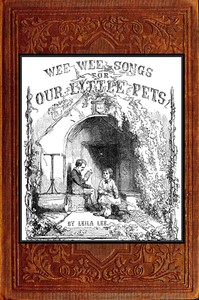
Wee Wee Songs for Our Little Pets — Edition Insights

(0 User reviews)   525
Lee, Leila, -1900 Project Gutenberg 2021 Not confirmed
Children's poetry; Conduct of life -- Juvenile poetry; Children -- Conduct of life -- Juvenile poetry; Christian life -- Juvenile poetry Readers of public-domain and historical texts
Project Gutenberg digital edition en

Edition facts

Words 26,015
Reading time 114 min
Text sections 8

Wee Wee Songs for Our Little Pets — Edition Insights can be approached with a clearer sense of reading commitment from its source measurements: 26,015 words, 1 hr 54 min estimated reading time, and 8 detected text sections.

The text analysis averages about 21.4 words per sentence, while the detected sections provide another way to judge how the source is divided.

Project Gutenberg metadata also associates the work with “Children's poetry,” connecting these edition facts with the source record’s subject description.

This 1859 children's poetry collection by Leila Lee uses simple rhymes to teach Christian morals, contrasting nursery nonsense with pious instruction. Poems move between domestic scenes and moral dialogues, often featuring children correcting their own faults after parental guidance.
Share

Read the complete public-domain text at its original source.

Read on Project Gutenberg

The preface of Wee Wee Songs for Our Little Pets frames the book as a corrective to nursery rhymes like “Mother Goose,” which the poem of that name calls “wicked and silly.” The speaker, Sue, questions why children should be told lies, and her mother agrees, wishing for rhymes that feed the mind “with something beside” mere jingle. This opening establishes a pattern: the poems are not just verses but arguments about proper reading material. Throughout the collection, children are shown learning to prefer pious thoughts over idle amusement, and the poems themselves become the approved substitute.

Rhyme as Moral Dialogue

The poems frequently take the form of a child addressing a doll, a parent, or a sibling, and the reply from an adult voice delivers the moral. In “Sleep, Dolly!” the speaker commands her doll to sleep so she can read “Wee-Wee Songs,” but the doll cannot hear—a small joke that underscores the poems’ intended audience. More extended dialogues, such as “Holiday Gift,” show a mother giving money to her children while hiding a care; Charles notices her troubled smile and asks about it, prompting a lesson on gratitude. The structure is consistent: a child’s impulse or question leads to an adult’s corrective explanation, often ending with the child’s reformed resolution.

Recurring Images of Restraint and Release

Several poems hinge on the contrast between being still and being active. “Sleep, Dolly!” and “Wake, Dolly!” form a pair: the first commands stillness for reading, the second releases the doll for play after the songs are put away. In “Remember the Poor,” the child is urged to pity those who “suffer in winter / For want of warm clothes,” turning the reader’s attention from personal comfort to charitable action. The image of the coach in the long poem about envy—where Melinda envies a girl who rides while she walks—is resolved when the mother reveals that the rider is crippled, making Melinda thankful for her own feet. Movement (walking, riding, playing) is repeatedly tied to moral condition.

The Child as Moral Agent

Children in these poems are not passive recipients of lessons; they actively question, reason, and correct themselves. Sue initiates the critique of Mother Goose. Melinda, after hearing the story of Jennie Wright, declares, “I shall feel thankful I can walk.” Charles perceives his mother’s hidden worry. The poems grant children the capacity to recognize sin—envy, selfishness, ingratitude—and to articulate their own reform. This agency is reinforced by the first-person voices: many poems are spoken by a child, not an adult narrator. The effect is to model self-examination for the young reader, making the moral instruction feel internal rather than imposed.

Domestic Settings and the World Beyond

The poems are anchored in the home—nurseries, parlors, gardens—but frequently gesture outward to the poor, the sick, and the urban Five Points district. “Remember the Poor” explicitly cites Jesus’ words and describes the “House of Industry” as a charitable institution. The coach poem moves from a country walk to a sickroom. This juxtaposition of cozy domesticity with distant suffering is a deliberate pedagogical tool: the child is taught to see beyond her own pleasures. Yet the settings remain generic; there are no named streets or landmarks except the Five Points, which serves as a shorthand for urban poverty. The poems thus create a moral geography where home is the site of learning and the outside world is a source of lessons.

Readers approaching Wee Wee Songs for Our Little Pets should attend to how the poems build their arguments through repetition and contrast. The same moral—be thankful, share, obey—appears in multiple guises, each time with a slightly different scenario. The book rewards attention to its small structural patterns: paired poems, question-and-answer formats, and the recurring image of a child who learns to prefer the “sweet words” of Jesus over idle tales. These are not random nursery jingles but a carefully designed curriculum in Christian sentiment.

There’s something touching about those old Wee Wee Songs, how gently they nudge a child toward goodness. I find myself thinking of that same earnest voice in Longfellow’s Dante, where every punished soul still yearns for a lesson learned. Both books feel like quiet rooms where someone once sat, hoping. Divine Comedy, Longfellow's Translation, Hell — Inside the Classic sits on my shelf now, a little worn, like a friend who’s aged beside me.

There are no reviews for this eBook.

0
0 out of 5 (0 User reviews )

Add a Review

Your Rating *
There are no comments for this eBook.

Reader reflection

Before you leave, reflect on the book

Use these questions to collect your thoughts before moving on.

Your progress 0 / 10
1

Which reading stage best describes you?

2

How did the book work for you overall?

3

Is this a title you would suggest to others?

4

How demanding did the text feel?

Related eBooks