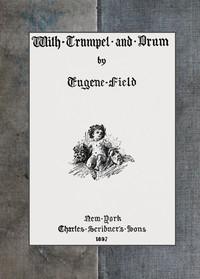
With Trumpet and Drum — Context and Discussion

(0 User reviews)   645
Field, Eugene, 1850-1895 Project Gutenberg 2020 Not confirmed
Children's poetry; Conduct of life -- Juvenile poetry; Children -- Conduct of life -- Juvenile poetry Readers of public-domain and historical texts
Project Gutenberg digital edition en

Edition facts

Words 15,437
Reading time 68 min
Text sections 4

The source record for With Trumpet and Drum — Context and Discussion measures this digital text at 15,437 words, 1 hr 8 min estimated reading time, and 4 detected text sections.

The text analysis averages about 27.3 words per sentence, while the detected sections provide another way to judge how the source is divided.

Project Gutenberg metadata also associates the work with “Children's poetry,” connecting these edition facts with the source record’s subject description.

Eugene Field's 1892 collection of children's verse, compiled from earlier works, uses recurring images of toys, lullabies, and domestic scenes to explore childhood innocence and loss. The poems shift between playful marches and poignant reflections, with a notable emphasis on absent or sleeping children.
Share

Read the complete public-domain text at its original source.

Read on Project Gutenberg

Eugene Field's With Trumpet and Drum (1892) opens with a title poem that establishes a central image: children marching with a big tin trumpet and little red drum, circling and filing until they march into the speaker's heart. This framing device—a sturdy old heart that succumbs to the blare and beat—recurs throughout the collection, which Field compiled from his earlier Little Book of Western Verse, Second Book of Verse, and newspaper columns. The poems repeatedly return to toys, lullabies, and domestic interiors, often with a wistful awareness of absence or mortality.

Marching and Circling: The Poems' Structural Patterns

The title poem's image of children marching in circles—"this way and that way they circle and file"—mirrors a structural tendency in the collection. Several poems employ repetitive, circular phrasing: "Lollyby, lolly, lollyby" and "Intry-Mintry" use nonsense refrains that mimic children's games. Others, like "Hi-Spy," explicitly invoke play as a timeless, cyclical activity: "girls are girls, and boys are boys, / And have been so since Abel's birth." This movement between specific scenes and universal patterns gives the verse a ritualistic quality, as if each poem is a turn in a larger game.

Toys as Witnesses to Absence

Field frequently personifies toys as faithful sentinels. In "Little Boy Blue," the little toy dog and toy soldier stand "sturdy and stanch" and "red with rust," awaiting a child who never returns. The poem's final lines—"they wonder, as waiting the long years through / In the dust of that little chair, / What has become of our Little Boy Blue"—use the toys' perspective to underscore loss. Similarly, "The Naughty Doll" and "Pittypat and Tippytoe" treat dolls as companions subject to neglect or wear. These objects become repositories of memory, outlasting the children who played with them.

Lullabies and the Threshold of Sleep

Many poems occupy the liminal space between waking and sleep. "Wynken, Blynken, and Nod" sails a wooden shoe through a "crystal light" of stars, while "Balow, my Bonnie" and "Norse Lullaby" soothe infants with repetitive, rocking rhythms. "At the Door" shifts this threshold to a parent's study: a toddler knocks "timorous" and pleads, "Please let me in,—it's only me." The speaker abandons his book to embrace the child, then imagines himself as a truant at Heaven's gate. This recurring movement toward sleep or death—often via a door or a boat—gives the collection a gentle, elegiac undertow.

Dialect and Domestic Voices

Field occasionally adopts dialect to render adult voices, as in "Father's Letter," where a father writes to his son in a colloquial Midwestern idiom: "I'll tell him crops are looking up, with prospects big for corn." The poem's homely details—a felon on Marthy's finger, the off-ox's hurt horn, Cy Cooper's yarns—contrast with the more lyrical lullabies. "Croodlin' Doo" similarly uses Scots-inflected speech to evoke a mother's tenderness. These shifts in register suggest that Field saw children's verse as encompassing not only fantasy but also the everyday speech of family life, grounding the collection in a specific, affectionate domesticity.

Readers approaching With Trumpet and Drum will find a collection that rewards attention to its recurring images—toys, doors, boats, and lullabies—and to the way Field moves between playful marches and quiet meditations on loss. The poems were compiled from several sources, so the sequence itself is not a narrative but a mosaic. Noticing how each piece echoes or departs from the others can deepen one's sense of Field's craft and his tender, unsentimental view of childhood.

That rainy afternoon, the toy soldiers in Field’s poems felt weightier than their brass—each one a small stand-in for children who never wake. I closed the book and reached for something else on the shelf, another voice asking what comes after such quiet sorrow. The verses in Renascence, and Other Poems — Reading Notes answered with a different kind of trembling, less about loss, more about breath returning.

There are no reviews for this eBook.

0
0 out of 5 (0 User reviews )

Add a Review

Your Rating *
There are no comments for this eBook.

Reader reflection

Take a moment to reflect on this book

Create a short personal record of your experience with this book.

Your progress 0 / 10
1

Which reading stage best describes you?

2

Was reading this book enjoyable?

3

Would you encourage someone else to read it?

4

How easy was the book to follow?

Related eBooks