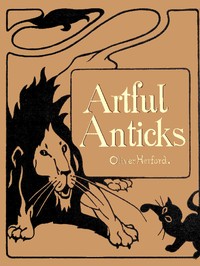
Artful Anticks — A Closer Reading

(0 User reviews)   774
Herford, Oliver, 1863-1935 Project Gutenberg 2018 Not confirmed
Children's poetry, American; Animals -- Juvenile poetry; Wit and humor, Juvenile Readers of public-domain and historical texts
Project Gutenberg digital edition en

Edition facts

Words 11,695
Reading time 51 min
Text sections 35

Artful Anticks — A Closer Reading can be approached with a clearer sense of reading commitment from its source measurements: 11,695 words, 51 min estimated reading time, and 35 detected text sections.

The text analysis averages about 16.8 words per sentence, while the detected sections provide another way to judge how the source is divided.

Project Gutenberg metadata also associates the work with “Children's poetry, American,” connecting these edition facts with the source record’s subject description.

Oliver Herford's 1901 collection of whimsical verse and fables, where animals and fairies debate, scheme, and philosophize in rhymed dialogues. The poems feature a persistent tension between authority and mischief, with characters like the audacious kitten, the artful ant, and the forgetful forget-me-not challenging expectations through wordplay and ironic reversals.
Share

Read the complete public-domain text at its original source.

Read on Project Gutenberg

Oliver Herford's Artful Anticks (1901) opens with a kitten who insists on sailing to see the Prince of Wales, brushing off warnings with the logic that 'if a Cat may look at a King, / A kitten may look at a Prince.' This early poem establishes a pattern of small creatures asserting their rights against larger forces, a theme that recurs throughout the collection. Herford's verses often hinge on a single witty premise—an ant who throws a ball without provisions, a spider who spins a yarn to protect his lunch—and develop it through rhymed stanzas that mix nursery-rhyme cadence with sly social commentary.

The Art of the Unprepared

The title poem, 'The Artful Ant,' introduces a hostess who invites five-score guests without any food. Her solution—'a bright Idea'—is teasingly withheld, leaving the reader to imagine the outcome. This pattern of setting up a problem and then sidestepping its resolution appears in several poems. In 'The Forgetful Forget-Me-Not,' a professor asks the flower about its name, but the flower evades the question by noting rain is coming. The poem ends with the flower admitting it has forgotten the origin itself. Herford uses these non-answers to poke fun at both the characters' pretensions and the reader's expectation of a tidy moral.

Voices in Dialogue

Many poems are structured as conversations, with each speaker given a distinct voice. In 'The Audacious Kitten,' the kitten's repeated refrain 'To look at the Prince of Wales!' contrasts with the cautious narrator's objections. 'The Spider's Tale' embeds a nested narrative: the poet tries to free a fly, but the spider interrupts with a long fable about a prince, a witch, and a 'Flyder.' The spider's tale is itself interrupted by asides and stage directions, creating a layered, metafictional effect. Herford often lets the trickster character have the last word, as when the spider's story ends with the princess driven mad by the Flyder's appearance.

Small Creatures, Large Ambitions

Herford's animal characters consistently overreach their apparent capacities. The kitten plans a sea voyage; the ant attempts to feed a crowd from nothing; a dormouse features in a 'deceitful' episode. Even the forget-me-not, a tiny flower, dismisses a professor's inquiry with cool condescension. The poems' humor arises from the gap between the characters' grand schemes and their actual situations. In 'The Birds' Farewell,' the birds write a polite letter to a little maid, promising to return in spring and learn new songs—but the postscript undercuts the sentiment by asking her to 'present our respectful regards to your cat.' The collection consistently treats its miniature protagonists with affectionate irony.

Readers will find that Artful Anticks rewards attention to its formal play: Herford varies line lengths, rhyme schemes, and stanza structures across the poems, and often embeds dialogue within narrative frames. The table of contents lists 35 pieces, many of which are short enough to be read aloud. The poems do not form a continuous story but share a tone of gentle mockery toward both human and animal pretensions. Approaching them as a sequence of comic vignettes rather than a unified work will best reveal their cumulative wit.

There’s a particular ache in rereading Herford’s verse now, that kitten’s logic tangled so gently with rebellion. I keep thinking of that old moralist, who somehow belongs beside it, not as a companion but as a quiet echo from a different shelf. Their shared mischief lingers, almost like a season I’ve misplaced. The infant moralist — Edition Insights brings that feeling back, tender and unresolved.

There are no reviews for this eBook.

0
0 out of 5 (0 User reviews )

Add a Review

Your Rating *
There are no comments for this eBook.

Reader reflection

Record your reading impressions

A brief reflection can help important ideas stay with you longer.

Your progress 0 / 10
1

How far have you progressed with this book?

2

Was reading this book enjoyable?

3

Would you encourage someone else to read it?

4

How easy was the book to follow?

Related eBooks