Elfin music — Edition Insights
Edition facts
This digital edition of Elfin music — Edition Insights is described by source-level measurements including 59,707 words, 4 hr 20 min estimated reading time, and 18 detected text sections.
The text analysis averages about 24.9 words per sentence, while the detected sections provide another way to judge how the source is divided.
Project Gutenberg metadata also associates the work with “English poetry,” connecting these edition facts with the source record’s subject description.
Read the complete public-domain text at its original source.
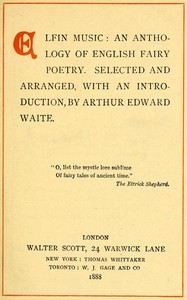
Read on Project GutenbergArthur Edward Waite's Elfin Music (1888) is an anthology that assembles English fairy poetry from Spenser to his own contemporaries, framed by an introduction that traces the lineage of fairy lore through medieval romance, Gothic and Celtic traditions, and the Romantic revival. The collection is notable for its deliberate arrangement: it moves from poems about the fairy family and court chronicles to travels in fairyland and encounters between mortals and fairies, creating a structured journey through the literary imagination of the supernatural.
Waite's editorial hand is evident in the selection's moral and spiritual undercurrents. The introduction discusses the fairies' religious faith and their stature, while the poems themselves often present fairy encounters as tests of virtue or visions of a higher order. The anthology does not merely gather charming verses; it proposes that fairy poetry carries a 'mystic lore sublime' that speaks to deeper truths about human experience and the natural world.
The Moral Weight of Fairy Encounters
Many poems in Elfin Music treat fairy meetings as morally charged events. In James Hogg's 'Kilmeny,' the heroine is taken to a visionary realm where she witnesses the sorrows of man and the eventual triumph of love and harmony. Her return is marked by a transformed, almost saintly beauty: 'her seymar was the lily flower, / And her cheek the moss-rose in the shower.' The poem insists that her purity and detachment from worldly pride are the fruits of her otherworldly journey. Similarly, John Keats's 'La Belle Dame Sans Merci' presents a fairy seduction that leaves the knight 'alone and palely loitering,' a warning against enchantment that lacks moral grounding. These poems, placed side by side, suggest that the fairy world is not merely whimsical but a realm that tests and reveals human character.
Contrasting Scales: From Queen Mab to the Elfin Court
The anthology juxtaposes poems that depict fairies as tiny, domestic creatures with those that portray them as regal and powerful. Ben Jonson's 'Queen Mab' describes her as 'the fairies' midwife,' a diminutive figure who 'comes / In shape no bigger than an agate-stone.' In contrast, Michael Drayton's 'Nymphidia' presents a full court with a king and queen, elaborate rituals, and a mock-heroic battle. William Shakespeare's 'Queen Mab' speech from Romeo and Juliet further complicates the scale: Mab is tiny yet her influence over human dreams is vast. This tension between the miniature and the majestic runs through the collection, inviting readers to consider whether fairies are best understood as playful sprites or as beings with genuine authority over nature and human fate.
Water Spirits and the Feminine Sublime
A striking cluster of poems in Elfin Music focuses on water spirits—mermaids, water nixies, and the Neckan—almost always female and often dangerous or melancholic. Thomas Hood's 'The Water Lady' portrays a water spirit who lures a mortal to her 'crystal cave' beneath the waves, while James Hogg's 'The Mermaid' sings a song of loss and longing. Sarah Williams's 'Song of the Water Nixies' and Margaret Dixon's 'A Legend of the Water-Spirit, called Neckan' continue this pattern, presenting water as a boundary between worlds. These poems share a vocabulary of 'silver,' 'pearl,' and 'coral,' and they often end with the mortal's death or disappearance. The recurrence of this motif suggests that Waite saw the water spirit as a particularly potent figure for exploring the allure and peril of the supernatural feminine.
Readers approaching Elfin Music will find that its value lies less in any single poem than in the conversations the anthology creates between them. Waite's arrangement rewards sequential reading: the fairy family gives way to chronicles, then to travels, and finally to encounters with mortals. Pay attention to how poems echo one another in imagery and theme—the recurring motifs of flowers, water, and moral transformation. The introduction provides a useful framework, but the poems themselves offer the richest evidence of how English poets have imagined the fairy realm across centuries.
Waite’s Elfin Music stayed with me for how gently it shows fairies as moral weight, not just sparkle. I kept thinking of that quiet gravity again while remembering The infant moralist — Edition Insights. Both felt like old, honest whispers about right and wrong, lingering the way lantern light does. Strange, how such small verses hold so much we still carry.
There are no reviews for this eBook.
Take a moment to reflect on this book
Create a short personal record of your experience with this book.