
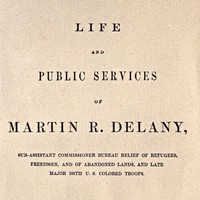
Life and public services of Martin R. Delany by Frank A. Rollin
Frank A. Rollin's biography, published in 1868, is our front-row seat to the incredible life of Martin R. Delany. It follows him from his childhood in Virginia and Pennsylvania, through his early work as an abolitionist newspaper editor alongside Frederick Douglass, to his groundbreaking admission to Harvard Medical School (and the racist backlash that followed). The story tracks his growing disillusionment with America, leading to his famous advocacy for Black emigration to Central or South America and, eventually, his own expedition to West Africa to negotiate land for a new settlement. The narrative then follows his critical role in the Civil War as the first Black field officer in the U.S. Army, and his work during Reconstruction.
The Story
This is the story of a man who refused to be boxed in. It starts with Delany's fight for education and a medical career, showing the everyday walls Black Americans faced in the North. We see his powerful partnership with Frederick Douglass and their eventual, famous split over strategy—Douglass for integration, Delany for emigration. The book takes us on his daring trip to Nigeria, a real-life adventure to secure a homeland. Then, when war breaks out, we see him pivot completely, recruiting Black soldiers and earning a major's commission, proving his loyalty to the Union cause was always about liberation. The final chapters cover his complex role in the turbulent years after the war, trying to build the freedom he'd always fought for.
Why You Should Read It
You should read this because Martin Delany is the fascinating, complicated figure most history classes leave out. He was a nationalist who served the Union, an emigrationist who worked within the system. Reading his life challenges the simple, single-path narratives we often get. Rollin, writing with the passion of someone who knew Delany and his era, makes you feel the weight of every impossible choice. You get frustrated with the injustices he faced, feel the hope of his African venture, and share in the bitter irony of his post-war struggles. This book isn't a dry history lesson; it's a portrait of a brilliant, stubborn, visionary man trying to find a way forward for his people when there were no clear maps.
Final Verdict
This book is perfect for anyone who loves biographies of towering, unyielding figures, or for readers who want to look beyond the usual names of the abolitionist movement. If you're interested in the deep debates within Black communities about identity, nationhood, and freedom, this is an essential primary source. It's also a compelling read for anyone who enjoys stories of real-life exploration and political drama. Be prepared for the 19th-century prose style, but push through—Delany's life is more than worth the journey.
There are no legal restrictions on this material. You can copy, modify, and distribute it freely.
Mary Lee
4 months agoAfter spending a few days with this digital edition, the step-by-step breakdown of the methodology is extremely helpful for students. I'm glad I chose this over the other alternatives.
Nancy Brown
1 year agoAfter finishing this book, it provides a comprehensive overview perfect for everyone. Truly inspiring.
Kimberly Sanchez
3 months agoThe index links actually work, which is rare!
Liam Harris
1 year agoAmazing book.










Jennifer Miller
6 months agoIt’s refreshing to see such a high standard of digital publishing.