Our Young Folks at Home and Abroad — Edition Insights
Edition facts
This digital edition of Our Young Folks at Home and Abroad — Edition Insights is described by source-level measurements including 86,057 words, 6 hr 15 min estimated reading time, and 14 detected text sections.
The text analysis averages about 17.0 words per sentence, while the detected sections provide another way to judge how the source is divided.
Project Gutenberg metadata also associates the work with “Children's poetry,” connecting these edition facts with the source record’s subject description.
Read the complete public-domain text at its original source.
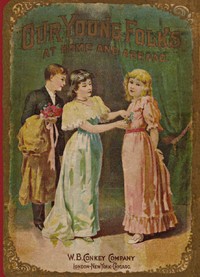
Read on Project GutenbergThe anthology Our Young Folks at Home and Abroad opens with a table of contents that reads like a catalogue of late-nineteenth-century juvenile concerns: animal life from every zone, lessons on seed planting, tales of firemen's dogs, and a poem about a laughing jackass. The editor, Daphne Dale, has assembled contributions from over a dozen writers, including Laura E. Richards and Oliver Optic, whose names would have been familiar to contemporary young readers. The collection's structure—mixing prose and verse, fiction and natural history—reflects an era when children's literature was expected to instruct as much as entertain.
Moral Lessons Woven into Everyday Scenes
The excerpt from the story of Katie Wilson illustrates how the anthology embeds moral instruction in domestic and outdoor settings. Katie, a girl who sells autumn leaves to earn money for her impoverished family, is described as 'brave, and true, and unselfish,' and her reward is both financial and emotional. The narrative emphasizes hard work and selflessness: Katie rises early, attends to household duties, and works hard to prepare her bunches of leaves. When she gives leaves to orphan children, the text notes that 'the girl's heart was touched.' The story avoids abstract preaching; instead, it shows Katie's actions and their consequences, allowing the moral to emerge from the plot.
Animal Encounters and Natural History
The anthology's table of contents lists numerous animal-centered pieces: 'The Porcupine's Quills,' 'The Opossum in the Hen-House,' 'A Bear-Story,' and 'The Laughing Jackass.' These titles suggest a blend of factual observation and fictional adventure. In the Katie Wilson excerpt, the setting includes mountain paths and fallen logs, placing the characters in a natural landscape where animals might appear. The collection seems to use animal stories to teach lessons about behavior and the natural world, a common strategy in nineteenth-century children's literature. The inclusion of 'Animal Life from Every Zone' as a section heading indicates a systematic approach to natural history education.
Dialogue and Characterization in Brief Encounters
The dialogue in the Katie Wilson excerpt is spare but revealing. When the old gentleman asks her name, she replies 'faintly,' and his response—'Um! um! Come along Helen'—is abrupt, yet he pays her fifty cents and says 'that was right.' Later, when Katie and Robbie are lost, the old man's question 'What are you doing here any how?' is met with Katie's fearful plea: 'don't hurt Robbie! We weren't doing any harm.' These exchanges convey character through tone and brevity. The anthology likely uses such concise dialogue to model polite speech and emotional restraint for young readers.
Structure and Variety in a Mixed-Genre Collection
With 14 text sections and over 86,000 words, Our Young Folks at Home and Abroad offers a wide variety of reading experiences. The table of contents lists poems like 'Hear Us Sing, See Us Swing, Up in the Old Oak Tree' alongside prose pieces such as 'How Roy Went a Fishing' and 'A Temperance Horse.' This mix of verse and narrative, fiction and non-fiction, would have kept young readers engaged while exposing them to different literary forms. The anthology's organization by topic—animals, nature, moral tales—suggests careful editorial planning to balance entertainment with education.
Readers approaching Our Young Folks at Home and Abroad should expect a diverse collection that reflects late-nineteenth-century ideals of childhood: industrious, obedient, and kind to animals. The stories and poems reward close attention to detail, as small gestures—a child offering leaves to orphans, a girl covering her sleeping brother with a cape—carry significant moral weight. The anthology is best read not as a continuous narrative but as a series of vignettes, each offering a glimpse into the values and entertainments of a bygone era.
There are evenings when I open Our Young Folks at Home and Abroad, that 1894 anthology, and the earnest sketches of Daphne Dale’s choosing feel like old, steady friends. It reminds me of Artful Anticks — A Closer Reading, which holds the same patient mischief between its pages. Both whisper of childhood’s quiet, untidy truths, nothing hurried, nothing loud.
There are no reviews for this eBook.
Before you leave, reflect on the book
Use these questions to collect your thoughts before moving on.