Poems — Background and Themes
Edition facts
Before opening Poems — Background and Themes, the edition data offers a quick orientation: 14,157 words, 1 hr 2 min estimated reading time, and 2 detected text sections.
The text analysis averages about 24.5 words per sentence, while the detected sections provide another way to judge how the source is divided.
Project Gutenberg metadata also associates the work with “English poetry,” connecting these edition facts with the source record’s subject description.
Read the complete public-domain text at its original source.
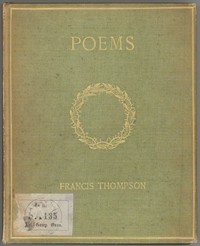
Read on Project GutenbergFrancis Thompson's Poems (1909) opens with a dedication that establishes a pattern of reciprocal offering: the poet gives back to his patrons what they have given him, figured as a mine yielding jewels or a vine surrendering grapes. This exchange of gifts and debts recurs throughout the volume. In 'Before Her Portrait in Youth,' the speaker treasures a beloved's 'cast youth' as a relic, reaching 'back through the days' to a dead past. The poem's structure—a lover's address to a portrait—mirrors the volume's broader concern with presence and absence, the living and the memorialized.
The Hound of Heaven: Pursuit as Unmaking
The volume's most famous poem, 'The Hound of Heaven,' dramatizes a divine chase in which the speaker is progressively stripped of defenses. The voice of the pursuer declares, 'All which I took from thee I did but take, / Not for thy harms.' The speaker describes being 'hewn' piece by piece, left 'defenceless utterly,' his 'mangled youth lies dead beneath the heap.' This is not a gentle calling but a violent unmaking: 'Thou char the wood ere Thou canst limn with it.' The poem's momentum builds through a series of losses—of power, of nature's comfort, of dream itself—until the speaker stands 'naked' awaiting 'Thy love's uplifted stroke.' The pursuit is relentless, the voice 'round me like a bursting sea.'
Nature's Silences and the Limits of Sympathy
In the same poem, Thompson explores a failed communion with the natural world. The speaker claims to have 'drew the bolt of Nature's secrecies,' understanding clouds, weather, and the 'wilful face of skies.' Yet he admits, 'we know not what each other says, / These things and I; in sound I speak— / Their sound is but their stir, they speak by silences.' Nature is a 'poor stepdame' who cannot slake his thirst. This tension between intimacy and alienation recurs in other poems: the dedication figures the poet as a 'viol to its witcher' with 'music lay hushed in it,' suggesting that expression requires an external agent to unlock it. The natural world, for all its beauty, remains mute to human need.
Relics, Vestures, and the Weight of the Past
Thompson frequently employs objects that hold the trace of a lost presence. In 'Before Her Portrait in Youth,' the speaker addresses a 'cast youth' as an 'outworn vesture, tenantless of thee,' which nonetheless 'cheateth me' with its semblance. The poem's central conceit—that a glove or kerchief can fleetingly summon the hand or neck—extends to the portrait itself, a 'ghostly sweetness' fashioned in absence. The dedication similarly treats the poet's work as a 'coffer' whose contents are returned to the 'loosers.' This preoccupation with relics and remains gives the volume a funereal quality: youth is a 'drooping flower' gathered for memorial, and the speaker vows to 'reach back through the days / A trothed hand to the dead the last trump shall not raise.' The past is not past but a weight carried into the present.
Readers approaching Thompson's Poems will find a voice that oscillates between ornate devotion and stark self-exposure. The poems reward attention to their intricate syntax and layered imagery, where a single line can shift from metaphysical conceit to raw confession. The volume's structure—moving from love poems to the great ode of pursuit to lighter pieces on children—invites comparison across sections, revealing how Thompson's themes of loss, dedication, and the limits of human sympathy recur in varied keys.
Reading Francis Thompson’s Poems again, I keep returning to that strange, stripped-bare feeling in “The Hound of Heaven”—how grace finds us only after everything else falls away. Winter holds a similar quiet, I think. Flipping through A book of Christmas verse — Edition Insights the other night, I found that same hush, only gentler, like snow settling over a long, tired year.
There are no reviews for this eBook.
Record your reading impressions
A brief reflection can help important ideas stay with you longer.