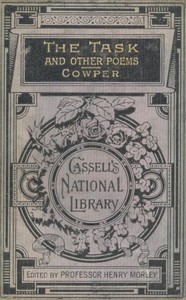
The Task, and Other Poems — Text and Context

(0 User reviews)   915
Cowper, William, 1731-1800 Project Gutenberg 2003 Not confirmed
English poetry -- 18th century Readers of public-domain and historical texts
Project Gutenberg digital edition en

Edition facts

Words 45,927
Reading time 200 min
Text sections 4

This digital edition of The Task, and Other Poems — Text and Context is described by source-level measurements including 45,927 words, 3 hr 20 min estimated reading time, and 4 detected text sections.

The text analysis averages about 26.6 words per sentence, while the detected sections provide another way to judge how the source is divided.

Project Gutenberg metadata also associates the work with “English poetry -- 18th century,” connecting these edition facts with the source record’s subject description.

An editorial note on William Cowper's 'The Task, and Other Poems,' focusing on his authorial choices in diction, dialogue, and description, with observations on the poem's origin, blank verse, and vivid winter scenes.
Share

Read the complete public-domain text at its original source.

Read on Project Gutenberg

William Cowper's The Task, and Other Poems originated from a playful challenge by Lady Austen, who urged him to write a poem in blank verse and suggested the subject: a sofa. This anecdote, recorded in the introduction, reveals the conversational and occasional nature of the work. Cowper's diction shifts between the colloquial and the formal, as when he describes the sofa's evolution from a stool to a 'sopha' with 'costlier fare.' The poem's blank verse allows for a flexible, meditative rhythm that accommodates both domestic observation and moral reflection.

The Sofa as a Starting Point

The poem's opening sections trace the history of seating from 'the softest moss' to 'the stately sofa,' a progression that Cowper uses to introduce his theme of luxury and its discontents. The description of the sofa itself is precise: 'the sumptuous alcove' with 'cushion'd sides' and 'a base of polished wood.' Yet Cowper's tone is wry, noting that 'the proudest seat' is but a 'throne of ease.' This blend of material detail and moral commentary is characteristic of his authorial voice. The sofa becomes a symbol of the refinement that Cowper both enjoys and questions, setting the stage for the poem's broader reflections on society and nature.

Blank Verse and Conversational Rhythm

Cowper's adoption of blank verse, at Lady Austen's suggestion, marks a departure from the rhymed couplets of his earlier work. The unrhymed iambic pentameter allows for a more natural, conversational flow, as seen in lines like 'I sing the sofa. I, who lately sang / Truth, Hope, and Charity, and touch'd with awe / The solemn chords.' The enjambment and varied pauses mimic speech, creating an intimate, reflective tone. This rhythm suits Cowper's tendency to move from specific observations to general reflections, as when he describes a winter scene and then moralizes on poverty. The blank verse also accommodates the poem's digressions, which are a hallmark of its structure.

Winter Scenes and the Poor

One of the most vivid passages in the excerpts depicts a winter landscape and the lives of the rural poor. Cowper's diction is concrete: 'the brown loaf / Lodged on the shelf, half-eaten, without sauce / Of sav'ry cheese.' He contrasts the 'frugal housewife' who 'trembles when she lights / Her scanty stock of brushwood' with the 'man' who 'feels least, as more inured than she / To winter.' The description of children 'with outspread hands / And crowded knees sit cowering o'er the sparks' is both tender and stark. Cowper's sympathy is evident, but he avoids sentimentality, noting that 'sleep seems their only refuge' and that 'sweet colloquial pleasures are but few.' These details ground the poem's moral concerns in specific, observable realities.

The Thief and the Moral Landscape

Cowper's portrayal of a 'nightly thief' prowling for plunder extends his social observation into the realm of crime and punishment. The thief is described with a mix of condemnation and grudging admiration: 'Uptorn by strength / Resistless in so bad a cause, but lame / To better deeds.' The image of him 'bundles up the spoil— / An ass's burden' and 'light of foot steals fast away' is almost cinematic. Cowper uses this figure to contrast with the 'honest pride' of the poor who 'scorn to beg.' The moral landscape is complex: the thief is a product of 'laziness or sottish waste,' yet the poem also critiques the 'knaves in office' who are 'partial in their work / Of distribution.' This nuanced view reflects Cowper's broader engagement with social justice.

Cowper's The Task rewards readers who attend to its local textures: the precise descriptions of objects, the shifts in tone from playful to somber, and the moral weight carried by everyday details. The poem's blank verse invites a slow, attentive reading, allowing the reader to follow Cowper's digressions and return to his central themes. As you read, note how the sofa—the poem's nominal subject—recedes and reappears, a thread that ties together observations on nature, society, and the self.

Reading about Cowper's quiet winter walks, the way he noticed the frost on every blade of grass, stirred a memory of curling up with The Task by lamplight. That calm, inward attention—the world slowed to a hush—felt oddly akin to how I once turned the pages of A book of Christmas verse — Edition Insights, noticing how each poem, too, seemed to hold its breath against the snow.

There are no reviews for this eBook.

0
0 out of 5 (0 User reviews )

Add a Review

Your Rating *
There are no comments for this eBook.

Reader reflection

What did you think of this book?

Answer a few questions and save a private reflection on this device.

Your progress 0 / 10
1

Have you finished this book?

2

How much did you enjoy the reading experience?

3

How likely are you to recommend this book?

4

What was the reading difficulty like?

Related eBooks