Poems of Experience — Background and Themes
Edition facts
For Poems of Experience — Background and Themes, the stored edition analysis reports 16,363 words, 1 hr 12 min estimated reading time, and 3 detected text sections.
The text analysis averages about 21.8 words per sentence, while the detected sections provide another way to judge how the source is divided.
Project Gutenberg metadata also associates the work with “American poetry,” connecting these edition facts with the source record’s subject description.
Read the complete public-domain text at its original source.
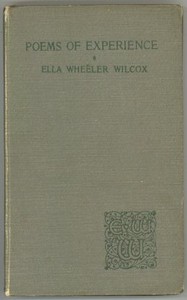
Read on Project GutenbergWilcox opens Poems of Experience with a controlling image: the soul as a golden vessel that must be emptied before it can be filled. In 'The Empty Bowl,' the speaker's plea for divine supply meets a voice that insists on self-emptying, establishing a pattern of spiritual discipline that runs through the collection. The poems that follow repeatedly return to containers, gardens, and journeys—each a figure for inner transformation. Wilcox's voice is direct and exhortative, often addressing the reader in second person or framing experience as a lesson. The collection moves between intimate lyrics and public poems, such as 'The London 'Bobby'' and 'Battle Hymn of the Women,' linking personal growth to broader social change.
Vessels and Gardens: Recurring Images of Containment and Growth
The opening poem, 'The Empty Bowl,' introduces the metaphor of the soul as a vessel that must be emptied of self before it can receive spiritual nourishment. This image recurs throughout the collection. In 'A Prayer,' the speaker asks that ill thoughts 'mould circumstance and bring ill luck,' treating the mind as a garden to be weeded. 'How the White Rose Came' tells a fable of a rose that turns white after heartbreak, using floral imagery to encode emotional change. The garden appears again in 'The Awakening,' where the speaker contrasts tropical lushness with the 'wonder of waking trees' in spring. These recurring images create a cohesive symbolic language: bowls, gardens, and vessels become figures for the self, which must be prepared, emptied, or tended before transformation can occur.
Movement Between Private Meditation and Public Address
Wilcox shifts between intimate, first-person lyrics and poems that speak to collective experience. 'Keep Going' uses direct address—'gird up your courage and say “I am strong”'—to exhort the reader toward perseverance. 'The London ‘Bobby’' offers a tribute to policemen, moving from a 'cosy corner' to public observation. 'Battle Hymn of the Women' and 'The Hymn of the Republic' adopt a communal, almost liturgical voice. This movement is not random: the private poems often establish a spiritual or emotional state that the public poems then apply to social conditions. For instance, 'The Empty Bowl'’s lesson of self-emptying prepares the ground for 'Progress,' which argues that 'the Race can rise but with the rise of all.' The collection thus enacts a dialectic between inner work and outer action.
Structure of Argument: From Problem to Resolution
Many poems follow a three-part structure: a problem is stated, a turning point occurs, and a resolution or insight is offered. In 'The Empty Bowl,' the speaker's complaint gives way to a voice from 'the vast invisible Somewhere' that reorients desire. 'Appreciation' argues that joy is known only through sorrow, using a logical progression: 'He knows not joy who has not first known sorrow.' 'I Look to Science' begins with a declaration of faith in science as a cure for crime and ends by renaming it 'The Great Religion of the Universe.' This pattern gives the collection a persuasive, almost sermonic quality. The poems do not simply express emotion; they argue for a way of seeing, often moving from particular image to general principle.
The Role of the Reader: Direct Address and Imperative Mood
Wilcox frequently uses the imperative mood and second-person pronouns to involve the reader. 'Keep Going' commands: 'gird up your courage,' 'brace up your mind,' 'smile and look up.' 'Be not attached' (as listed in the contents) likely continues this mode. Even in poems that begin in first person, the speaker often generalizes to 'we' or 'you,' as in 'Appreciation': 'We must have listened to the winter’s rune.' This technique creates a sense of shared experience and moral instruction. The reader is positioned as a student of life, learning from the speaker's trials. The closing lines of 'Keep Going'—'that which you strive for you yet shall attain'—exemplify the collection's optimistic, didactic tone. Wilcox's voice is that of a mentor who has earned the right to advise through her own 'experience.'
Tension Between Faith and Doubt in Scientific Progress
Several poems grapple with the relationship between religious faith and scientific reason. 'I Look to Science' explicitly calls science 'that bold denier of accepted creeds' and predicts it will 'reveal God’s secrets to the world.' Yet the poem ends by renaming science a religion, suggesting a synthesis rather than a conflict. 'If Christ came Questioning' (from the contents) likely continues this theme. In 'Progress,' Wilcox critiques societies that 'toil to feed a Monarch' as building 'a narrowing wall' against creation's purpose. These poems reflect a late-Victorian optimism about progress tempered by a concern for spiritual meaning. Wilcox does not reject faith but seeks to reconcile it with empirical knowledge, a tension that gives the collection intellectual weight beyond its simple forms.
Readers approaching Poems of Experience will find a collection that rewards attention to its recurring symbols and argumentative structure. Wilcox's poems are best read not as isolated lyrics but as parts of a coherent spiritual and social vision. The movement from private vessel to public garden, from personal prayer to collective hymn, traces a path from self-culture to social reform. The book's title is literal: these are poems shaped by lived experience, offered as both testimony and instruction.
I keep returning to that old Wilcox collection, the way her bowls and gardens hold quietness. It made me think of another volume I once knew, one I found again lately—Poems — Background and Themes—not because they match, but because both seem to wait for the same unhurried hour. Memory does that, stitching familiar pages together.
There are no reviews for this eBook.
How will you remember this book?
Save your reaction, strongest insight, and memorable passage.