Poems of the Past and the Present — Text and Context
Edition facts
For Poems of the Past and the Present — Text and Context, the stored edition analysis reports 21,230 words, 1 hr 33 min estimated reading time, and 4 detected text sections.
The text analysis averages about 23.6 words per sentence, while the detected sections provide another way to judge how the source is divided.
Project Gutenberg metadata also associates the work with “English poetry,” connecting these edition facts with the source record’s subject description.
Read the complete public-domain text at its original source.
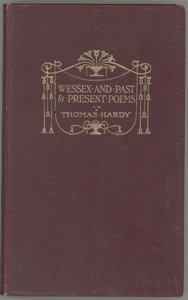
Read on Project GutenbergHardy's Poems of the Past and the Present opens with a section of war poems, including 'Embarcation' and 'Departure,' that treat military departure with a restrained, almost documentary tone. The collection then shifts to 'Poems of Pilgrimage,' where locations such as Genoa, Rome, and Lausanne anchor reflections on history and mortality. A long 'Miscellaneous Poems' section follows, containing the well-known 'The Darkling Thrush' and 'The Ruined Maid,' alongside lesser-known pieces like 'The Caged Thrush Freed and Home Again.' The volume closes with 'Imitations' and a 'Retrospect' section. Across these divisions, Hardy employs a wide range of stanza forms and meters, from villanelle to Sapphic fragment, and his voice remains consistently skeptical, attentive to the small and the overlooked.
War and Pilgrimage: Two Opening Frames
The first two sections establish contrasting modes. The war poems—'Embarcation,' 'Departure,' 'The Going of the Battery'—focus on collective experience and the machinery of conflict, often through a third-person perspective that keeps emotion understated. In 'A Wife in London,' the news of a soldier's death arrives via telegram, a detail that grounds grief in modern communication. The pilgrimage poems shift to a first-person speaker visiting historical sites: Shelley's skylark, Gibbon's garden, the Matterhorn. Here Hardy measures personal feeling against monumental time, as in 'Lausanne: In Gibbon's Old Garden,' where the historian's shadow lingers. Readers moving through these sections will notice how Hardy alternates between public and private registers, a pattern that recurs throughout the volume.
Memory, Oblivion, and the Second Death
A cluster of poems in the 'Miscellaneous' section directly addresses the fate of being forgotten. 'The To-be-Forgotten' gives voice to the dead who fear 'blank oblivion'—a 'second death' worse than physical dissolution. The speaker hears the dead lament that they were 'but Fortune's sport,' neither shunning nor seeking greatness. 'His Immortality' traces a dead man's presence fading from communal memory to a 'feeble spark' in the speaker alone. 'The Superseded' uses a refrain—'drop behind'—to voice the anxiety of being overtaken by newer generations. These poems share a plain, almost colloquial diction and a repetitive structure that reinforces their obsessive theme. Hardy does not offer consolation; the dead simply merge into those 'whose story no one knows.'
Small Creatures and Earth-Secrets
Several poems turn attention to insects and birds, often in domestic settings. 'An August Midnight' describes a moth, a 'dumbledore' (bumblebee), and a fly that gather around the speaker's lamp. The poem ends with the speaker musing that these 'humblest' creatures 'know Earth-secrets that know not I.' 'The Caged Thrush Freed and Home Again' uses the villanelle form to contrast human and avian knowledge: 'Men know but little more than we.' In 'Birds at Winter Nightfall,' birds huddle against the cold, and 'The Puzzled Game-Birds' questions the logic of their hunters. These pieces are brief, often under twenty lines, and their tone is observational rather than sentimental. They suggest that Hardy finds in the natural world a source of mystery that eludes human understanding.
Formal Range and the Speaker's Stance
Hardy's technical variety is evident throughout. 'The Caged Thrush' is a villanelle; 'Sapphic Fragment' and 'Catullus: xxxi' are translations that showcase his engagement with classical meters. 'The Respectable Burgher on the Higher Criticism' is a satirical monologue in rhyming couplets, while 'Tess's Lament' adopts a ballad-like simplicity. The speaker across these poems is consistently a detached observer—sometimes a mourner, sometimes a pilgrim, rarely a participant. In 'The Darkling Thrush,' the speaker leans upon a 'coppice gate' and hears a thrush's song that seems 'blessed Hope' but which he cannot share. This stance of skeptical witness, combined with Hardy's preference for concrete detail over abstraction, gives the collection a unified tone despite its formal diversity. Readers should attend to how each poem's structure reinforces its argument.
Reading Poems of the Past and the Present sequentially reveals Hardy's deliberate arrangement: war gives way to pilgrimage, then to a miscellany that circles back to themes of time, nature, and oblivion. The 'Imitations' and 'Retrospect' sections at the end offer a coda, with 'Memory and I' and 'I Have Lived with Shades' returning to the personal. For a first reading, consider how the shorter poems—especially those about insects and birds—function as counterpoints to the longer meditations on history and fame. Hardy's voice is consistent but never monotonous; his formal skill rewards attention to line and stanza.
I keep thinking about how Hardy holds loss so gently, letting the sea and the stones absorb what people can't say out loud. It made me remember another quiet book, where everyday routines carried the same weight of trying to hold onto something fleeting. Civil service jingles and other things — Text and Context has that same patient, unhurried ache, like noticing how a single word can sound different years later.
There are no reviews for this eBook.
Take a moment to reflect on this book
Create a short personal record of your experience with this book.