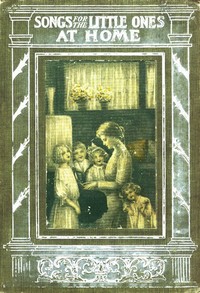
Songs for the Little Ones at Home — Story, Setting & Ideas

(0 User reviews)   314
Ward, Mary O. [Compiler] Project Gutenberg 2017 Not confirmed
Children's poetry; Conduct of life -- Juvenile poetry; Children -- Conduct of life -- Juvenile poetry; Children's songs Readers of public-domain and historical texts
Project Gutenberg digital edition en

Edition facts

Words 32,857
Reading time 143 min
Text sections 14

Songs for the Little Ones at Home — Story, Setting & Ideas can be approached with a clearer sense of reading commitment from its source measurements: 32,857 words, 2 hr 23 min estimated reading time, and 14 detected text sections.

The text analysis averages about 23.4 words per sentence, while the detected sections provide another way to judge how the source is divided.

Project Gutenberg metadata also associates the work with “Children's poetry,” connecting these edition facts with the source record’s subject description.

This collection of children's poems and songs, compiled by Mary O. Ward, reveals a consistent authorial voice that blends moral instruction with domestic and natural imagery. The verses employ simple rhyme schemes, repetitive structures, and direct address to teach kindness, obedience, and faith, often using animals and everyday scenes as metaphors.
Share

Read the complete public-domain text at its original source.

Read on Project Gutenberg

The compiler Mary O. Ward has assembled a volume where the moral and the musical intertwine. The verses consistently employ a direct, instructive tone, as seen in “Little drops of water, Little grains of sand, Make the mighty ocean” — a pattern that builds ethical lessons from small, concrete elements. The poems often address a child listener with second-person pronouns, creating an intimate, tutorial atmosphere. The frequent inclusion of musical notation (airs, bass accompaniments) suggests these were meant to be sung aloud, reinforcing the didactic purpose through rhythm and repetition.

Domestic Piety and the Idealized Home

The home is repeatedly portrayed as a sacred space where virtue is cultivated. In “Jesus Dwells Within,” the fireside is a place where “Love rules the hours” and “All goes so well” because of divine presence. The poem “The Father’s Will” explicitly links domestic duty to heavenly obedience: “How sweet the home of Nazareth / Where Mary mother smiled.” The compiler selects verses that elevate daily chores and family relationships into acts of worship. The word “lowly” appears in multiple poems, suggesting humility as a key domestic virtue. The home is not just a setting but a moral arena where children learn to emulate Christ through simple tasks and kind words.

Animals as Moral Mirrors

Animals in this collection serve as vehicles for ethical instruction. “Mary and Her Lamb” explicitly teaches that kindness to animals is reciprocated: “Oh, Mary loves the lamb, you know.” “The Little Fish” warns against disobedience through a fatal hook, while “Of What Are Your Clothes Made?” enumerates animal contributions to human comfort, concluding that “we should treat them as well as we can.” The dialogue poem “The Reindeer and the Rabbit” contrasts the usefulness of the reindeer with the vulnerability of the rabbit, but both are presented as deserving care. The compiler consistently uses animal characters to model or caution against human behaviors, often with a direct moral tag at the poem’s end.

Rhythmic Repetition and Oral Tradition

Many poems employ refrains, cumulative structures, or onomatopoeia suited for recitation. “Slumber Islands” uses a chorus with rowing motions: “Ho, ho, ho! in Dreamland boats we go, / Row, row, row, oh.” “Country Music” strings together animal and human sounds—“The cock is crowing, / The cows are lowing”—in a list that mimics the cacophony of a farm. The repeated “Little” in “Little Drops of Water” and the anaphora in “The Father’s Will” (“That will for ever done in Heav’n”) create memorable patterns. These devices suggest the verses were designed for memorization and group singing, reinforcing their lessons through oral repetition.

The Shepherd Metaphor and Divine Protection

The image of the shepherd recurs across several poems, linking pastoral imagery to spiritual care. In the excerpted “The Pet Lamb,” a maiden tethers a lamb, and the shepherd leads sheep to a “peaceful fold.” The poem “ASLEEP” (partially shown) continues this motif: “The shepherd comes with care, / And leads them to his peaceful fold.” The compiler extends the metaphor explicitly: “But you a Shepherd have above, / Of all kind shepherds best.” This consistent use of the shepherd figure aligns the collection with Christian allegory, where the child is the lamb and Christ is the shepherd. The metaphor appears in multiple sections, suggesting it was a deliberate organizing theme.

Readers will notice that the compiler favors poems with clear moral conclusions and repetitive structures, making them suitable for memorization. The verses often pair a concrete image—a drop of water, a lamb, a fish—with an abstract lesson. Pay attention to how the poems shift between narrative and direct address; this variation in voice keeps the instruction from becoming monotonous. The collection rewards reading aloud, as the rhythms and rhymes were clearly crafted for the ear as much as the eye.

I keep thinking about how Songs for the Little Ones at Home taught kindness through a lamb’s quiet stumble, and it reminded me of another book that lingers in that same gentle way—Artful Anticks — A Closer Reading. The way it notices small, awkward gestures made me pause, like finding an old photograph of a moment I’d almost forgotten.

There are no reviews for this eBook.

0
0 out of 5 (0 User reviews )

Add a Review

Your Rating *
There are no comments for this eBook.

Reader reflection

Record your reading impressions

A brief reflection can help important ideas stay with you longer.

Your progress 0 / 10
1

Have you finished this book?

2

Was reading this book enjoyable?

3

Would you encourage someone else to read it?

4

Did the language feel accessible?

Related eBooks