
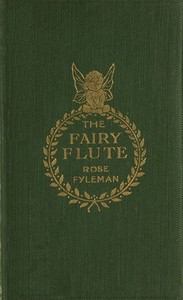
The fairy flute — Edition Insights
Edition facts
For The fairy flute — Edition Insights, the stored edition analysis reports 7,260 words, 32 min estimated reading time, and 2 detected text sections.
The text analysis averages about 26.7 words per sentence, while the detected sections provide another way to judge how the source is divided.
Project Gutenberg metadata also associates the work with “Children's poetry, English,” connecting these edition facts with the source record’s subject description.
Read the complete public-domain text at its original source.
Read on Project GutenbergRose Fyleman's The Fairy Flute (1921) presents a fairy world that is less ethereal and more domestic than many readers might expect. The poems repeatedly ground fairy behavior in the routines and objects of childhood: fairies love silver paper and ribbon bows, they think peppermint is the nicest thing they know, and they expect satin stools when they come to tea. This editorial note examines how the catalog subjects—Children's poetry, English and Fairy poetry, English—align with the actual content of the excerpts, focusing on the poems' voice, structure, and recurring details.
Domestic Details and Fairy Etiquette
The excerpts reveal a fairy realm governed by rules and preferences that mirror human domestic life. In "If You Meet a Fairy," the speaker advises showing a fairy around the garden and house, noting that fairies "always" want to see the kitchen. The poem "A Complaint" humorously scolds humans for stealing mushrooms, which fairies use as "satin stools" for tea guests. This detail—fairies needing furniture for social calls—is a recurring motif: "The grass is often very wet / And furniture is hard to get." Such lines transform fairies from distant magical beings into neighbors with practical concerns. The catalog subject "Fairy poetry, English" accurately describes the subject matter, but the poems' emphasis on etiquette and material objects suggests a more quotidian fairy culture than the term might imply.
Voice and Address: Direct Instructions to Children
Fyleman's poems frequently adopt a direct, instructional tone aimed at a child reader. "If You Meet a Fairy" opens with a command: "Don't run away." The speaker then recounts a cautionary tale of a girl who hid from fairies and "grew up very solemn / And rather ugly too." Similarly, "Useful Hints" (not fully excerpted but listed in the contents) implies practical advice. This voice positions the poems as a guidebook for interacting with fairies, blending fantasy with behavioral lessons. The catalog subject "Children's poetry, English" fits this didactic element, but the excerpts show that the instruction is often playful and embedded in narrative, as in "Prepare!" where animals are told to groom themselves for the Queen's arrival. The voice is consistently that of an experienced elder sharing secrets, not a distant narrator.
Recurring Imagery: Stars, Silver, and the Moon
Across the excerpts, certain images recur with notable frequency. Stars appear in "Every Fairy has a Star" and "A Voyage," where the boat sails through "shining crowds" of stars. Silver is a favored material: the boat in "A Voyage" is made of glass, and the fairy folk climb a "little silver stair" to enter a garden. The moon serves as an anchor point and a gateway. These repeated details create a consistent visual vocabulary that ties the poems together. However, the catalog subjects do not capture this specific imagery; they classify the work broadly under "Fairy poetry" without noting the particular motifs that distinguish Fyleman's fairyland. The poems also include darker notes—"A Complaint" threatens illness, and "Sometimes" hints at fleeting magic—that complicate the purely whimsical label.
Readers approaching The Fairy Flute will find a collection that rewards attention to its small, concrete details: the silver paper, the stolen mushrooms, the fairy who wants to see the kitchen. The poems are best read as a series of interconnected vignettes rather than a single narrative. Fyleman's fairies are not remote spirits but neighbors with opinions and needs, and the poems' direct address invites the reader into a playful, slightly mischievous relationship with them.
Years ago, I shelved Rose Fyleman’s fairy poems beside Elfin music — Edition Insights, and they seemed to nod at one another. Both know that magic hides in ordinary fields, in a flattened grass circle, in a tune carried past the hedge. I still recall that hush between their pages, like two friends sharing a secret without ever saying a word.
There are no reviews for this eBook.
What was your reading experience?
Capture what you thought, learned, and would like to remember.