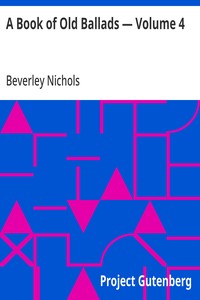
A Book of Old Ballads — Volume 4 — Story, Setting & Ideas
Edition facts
The source record for A Book of Old Ballads — Volume 4 — Story, Setting & Ideas measures this digital text at 12,261 words, 54 min estimated reading time, and 2 detected text sections.
The text analysis averages about 25.0 words per sentence, while the detected sections provide another way to judge how the source is divided.
Project Gutenberg metadata also associates the work with “Ballads, English -- Texts,” connecting these edition facts with the source record’s subject description.
Read the complete public-domain text at its original source.
Read on Project GutenbergThe volume opens with 'Edward, Edward,' a Scottish ballad built entirely on a question-and-answer exchange between a mother and her son. The mother's repeated queries—'Quhy dois zour brand sae drop wi' bluid?'—drive the poem forward, each answer revealing a more terrible confession. The archaic Scots spelling and incremental repetition create a mounting sense of dread. This is followed by 'King Leir and His Three Daughters,' a ballad version of the familiar story, rendered in straightforward English quatrains. The contrast in language and structure between these two opening pieces immediately signals the range of material Nichols has selected.
Dialogue as Dramatic Engine
'Edward, Edward' uses a strophic form where each stanza pairs a question from the mother with an answer from Edward. The mother's lines are nearly identical across stanzas, varying only the object of inquiry: first a hawk, then a horse, then his father. This repetition forces the reader to focus on the incremental revelation of guilt. The final stanza delivers a devastating reversal: Edward curses his mother for the counsel she gave him. The entire poem is a single scene, with no narrative intervention, making it a powerful example of how ballads can achieve dramatic intensity through minimal means.
Moral Frameworks in Traditional Verse
'King Leir and His Three Daughters' presents a clear moral structure: the king tests his daughters' love, the two eldest flatter while the youngest speaks honestly, and the king's rash judgment leads to his downfall. The ballad condenses the story into a series of emblematic episodes, each reinforcing the theme of filial duty and the danger of valuing words over deeds. Unlike 'Edward, Edward,' this ballad includes a narrator who guides the reader through the tale, offering commentary such as 'So on a time it pleas'd the king / A question thus to move.' The contrast in narrative voice between these two ballads highlights the formal variety within the collection.
The Shift to Literary Balladry
The final excerpt, from Oscar Wilde's 'The Ballad of Reading Gaol,' marks a departure from the anonymous folk tradition. Written in the late nineteenth century, it employs a more elaborate stanza form and a first-person narrator who witnesses an execution. The language is deliberately literary: 'crooked shapes of Terror crouched,' 'the damned grotesques made arabesques.' Wilde uses vivid, often grotesque imagery to evoke the psychological horror of prison life. The poem's length and narrative complexity contrast sharply with the concise, dialogic form of 'Edward, Edward,' showing how the ballad genre evolved to accommodate personal expression and social critique.
Recurring Motifs Across Centuries
Despite their differences, the ballads share recurring motifs. Violence and death appear in nearly every piece: Edward kills his father, King Leir's daughters plot against him, and the Reading Gaol narrator describes a hanging. The natural world is often used as a backdrop or symbol—the 'reid-roan steid' in 'Edward, Edward,' the 'moaning wind' in Wilde's poem. Another common thread is the presence of a maternal figure: Edward's mother, King Leir's daughters, and the 'Wife of Usher's Well' (listed in the contents). These recurring elements give the collection a cohesive thematic texture, even as the ballads span different centuries and styles.
Readers approaching this volume should attend to the editorial choices: Nichols has juxtaposed anonymous folk ballads with a known literary work, inviting comparison. The excerpts suggest that the collection rewards attention to form—how each ballad structures its story, whether through dialogue, narration, or lyric meditation. The appendix, mentioned in the contents, may offer further context on the sources. A first reading might focus on the variety of voices and the ways each ballad handles the themes of loss, guilt, and justice.
The rain kept time with the grim dialogue of “Edward, Edward,” yet afterward I found myself drifting toward something lighter, an old volume of Holmes’s verses about Bunker Hill. Both carry echoes of sacrifice, though one speaks in blood and the other in measured, stoic pride. That afternoon, they sat quietly together on my lap. The Poetical Works of Oliver Wendell Holmes — Volume 08 Bunker Hill and Other Poems — Story, Setting & Ideas felt like a hand on my shoulder after a long lament.
There are no reviews for this eBook.
What was your reading experience?
Capture what you thought, learned, and would like to remember.