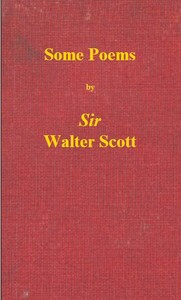
Some Poems — Edition Insights
Edition facts
For Some Poems — Edition Insights, the stored edition analysis reports 16,470 words, 1 hr 12 min estimated reading time, and 2 detected text sections.
The text analysis averages about 30.6 words per sentence, while the detected sections provide another way to judge how the source is divided.
Project Gutenberg metadata also associates the work with “Poetry,” connecting these edition facts with the source record’s subject description.
Read the complete public-domain text at its original source.
Read on Project GutenbergThe collection opens with 'The Vision of Don Roderick,' a poem written in 1811 for a fund aiding Portuguese sufferers, and closes with 'The Field of Waterloo' from 1815. Scott frames both works within a 'thin haze of battle,' but the poems themselves move through sharply contrasting landscapes: from the tangled forest of Soignies, where 'no opening glade dawns on our way,' to the sudden brightness of cornfields and hamlets near the battlefield. The structure relies on a journey motif—the reader is led along a 'straight causeway' through unvarying shade before emerging into a scene where the ground itself becomes a memorial.
The Vision as Structural Frame
In 'The Vision of Don Roderick,' Scott uses a legendary tower and cave from Spanish history as a framing device. The tower, with its 'narrow entrance' and iron gate, is described as a place where 'many kings desired to know the mystery' but were met with 'tremendous noise' and fear. This fable becomes the springboard for a vision of the Peninsular War. The poem shifts between the supernatural enclosure of the cave and the open battlefield, where 'Lusitania’s fallen shield' is restored. Scott’s note on the Greek inscription—'The King who opens this cave … will discover both good and evil things'—suggests a deliberate ambiguity: the vision is not simply heroic but carries a warning about the costs of war.
Recurring Images of Mist and Light
Across the poems, mist and light function as recurring visual motifs. In 'The Field of Waterloo,' the opening stanzas describe a 'brown tapestry of leaves' and a path where 'no streamlet, glancing to the ray' crosses the way. The forest is 'pathless' and 'blighted,' a space of concealment. Later, the scene shifts to 'sunny meads' and 'corn-fields glance between,' but this brightness is immediately undercut: 'when these ears were green, / Placed close within destruction’s scope.' Scott repeatedly juxtaposes natural beauty with imminent violence. In 'The Vision of Don Roderick,' the 'mist' that rolls away from the battlefield is likened to 'Gaul’s proud legions,' making weather a metaphor for military defeat.
Movement Between Enclosure and Open Ground
The poems are structured around a dialectic of confinement and release. In 'The Field of Waterloo,' the reader is first immersed in the 'tangled forest ground' of Soignies, where 'stems planted close by stems defy / The adventurous foot.' The causeway is 'unvarying through the unvaried shade.' Then, abruptly, 'a brighter, livelier scene succeeds'—the wood recedes, and the landscape opens into hedgerows and hamlets. This movement mirrors the approach to the battlefield itself: the 'shattered hedge' crests a hill, and the ground 'sinks so gently on the dale' before rising again to form an 'opposing screen.' The terrain becomes a series of thresholds, each one marking a shift in narrative tone.
The Poet as Navigator
Scott frequently employs nautical imagery to describe his own poetic progress. In the closing stanzas of 'The Vision of Don Roderick,' he writes: 'By shoal and rock hath steered my venturous bark, / And landward now I drive before the gale.' The poem itself is a voyage, with the poet as pilot. He 'furl[s] his weary sail' and 'strike[s] his red-cross flag' upon reaching land. This self-reflexive gesture frames the act of writing as a perilous journey, parallel to the military campaigns he describes. Similarly, in 'The Field of Waterloo,' the opening lines address Brussels as 'thou art far behind,' suggesting a departure from the known world into a space where time and distance are measured by the sound of bells and the 'fall' of the hour.
Readers attentive to Scott’s handling of space will notice how he uses landscape as a narrative device: the forest, the cave, the ridge, and the plain are not merely settings but active elements that shape the poem’s rhythm. The movement from enclosure to openness, from mist to light, from the legendary past to the recent present, gives these poems a structural coherence that rewards careful attention to transitions.
That grey afternoon, the mist in Scott’s Peninsula poems kept blurring into the rain on my window, each shattered hedge a small, distant grief. I closed the book, and somehow my hand found Main Street, and Other Poems — Edition Insights instead. It was quieter there—no cannons, just the hush of a village after battle, and I let that stillness settle.
There are no reviews for this eBook.
How did this book work for you?
Your answers remain private and are stored only in this browser.