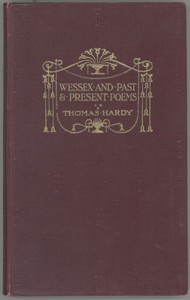
Wessex Poems and Other Verses — Edition Insights
Edition facts
The catalog record for Wessex Poems and Other Verses — Edition Insights provides practical reading context through 18,619 words, 1 hr 21 min estimated reading time, and 4 detected text sections.
The text analysis averages about 23.0 words per sentence, while the detected sections provide another way to judge how the source is divided.
Project Gutenberg metadata also associates the work with “English poetry,” connecting these edition facts with the source record’s subject description.
Read the complete public-domain text at its original source.
Read on Project GutenbergThomas Hardy's Wessex Poems and Other Verses (1898) opens with a preface that insists the pieces are 'in a large degree dramatic or personative in conception,' even when not obviously so. This claim is borne out by the collection's range: alongside intimate lyrics like 'Neutral Tones' and 'Hap' stand narrative poems such as 'The Dance at the Phoenix' and 'The Casterbridge Captains,' which recount specific historical or local events. Hardy also notes his use of 'ancient and legitimate word of the district' where no equivalent existed in received English, embedding the poems in the landscape and speech of Wessex. The result is a volume that oscillates between personal confession and regional storytelling, between the desire for transcendent meaning and the starkness of material fact.
Dramatic Voices and Regional Speech
The preface's claim that the poems are 'dramatic or personative' is substantiated by the variety of speakers. 'The Sergeant's Song' adopts a military cadence, while 'The Stranger's Song' and 'The Peasant's Confession' present distinct rural perspectives. Hardy's use of dialect words—such as 'tranter' in 'The Fire at Tranter Sweatley's'—anchors the verse in a specific locale. Yet the poems also employ formal, sometimes archaic diction: 'Thwart my wistful way did a damsel saunter' from 'The Temporary the All' shows a deliberate contrast between colloquial and elevated registers. This interplay suggests Hardy's effort to render local experience without sacrificing poetic ambition.
The Search for Signs in an Unanswering World
Several poems explicitly grapple with the failure of cosmic or supernatural response. In 'A Sign-Seeker,' the speaker catalogs natural phenomena—'the lightning-blade, the leaping star,' 'the earthquake's lifting arm'—yet laments that 'none replies' to his longing for a sign from the dead. The poem ends with the bleak aphorism 'When a man falls he lies.' Similarly, 'Nature's Questioning' personifies natural forces as 'Chastened children' who ask 'Has some Vast Imbecility, / Mighty to build and blend, / But impotent to tend, / Framed us in jest, and left us now to hazardry?' The collection repeatedly stages a confrontation between human yearning for meaning and an indifferent or inscrutable universe.
The Weight of the Past and the Chance of War
Historical poems like 'The Casterbridge Captains' and 'Leipzig' treat war as a crucible of chance and moral ambiguity. In 'The Casterbridge Captains,' a survivor of the Khyber Pass returns to find the names of his fallen comrades carved in a school panel: 'Unequal since.—'Twas theirs to aim, / Mine was it to fulfil!' The poem undercuts triumphalism by noting that 'Another chance, and they'd sat here, / And he had lain afar.' The survivor's laurels feel hollow, and the dead are granted a 'majesty' the living lack. These poems do not celebrate heroism but dwell on the arbitrariness of survival and the haunting presence of those who did not return.
Readers approaching Wessex Poems should attend to the tension between Hardy's preface—which emphasizes dramatic impersonation—and the persistent first-person voice of poems like 'A Sign-Seeker' and 'Neutral Tones.' The collection rewards attention to its local vocabulary, its metrical variety, and its recurring motifs of thwarted expectation. The poems do not form a unified sequence but rather a mosaic of perspectives, each testing the possibility of connection across the gaps of death, time, and indifference.
Reading these Wessex poems, I remembered standing in my grandfather’s garden, staring at a faded sundial that still worked. That same ache of time passing quietly returned when I later picked up Poems — Volume 1 — Context and Discussion — another book that seemed to hold the weather of a whole life inside its pages, without ever raising its voice.
There are no reviews for this eBook.
Record your reading impressions
A brief reflection can help important ideas stay with you longer.