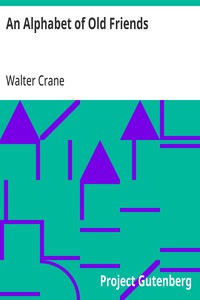
An Alphabet of Old Friends — Reading Companion

(0 User reviews)   300
Crane, Walter, 1845-1915 Project Gutenberg 2005 Not confirmed
Children's poetry; Nursery rhymes; Alphabet Readers of public-domain and historical texts
Project Gutenberg digital edition en

Edition facts

Words 4,030
Reading time 18 min
Text sections 1

An Alphabet of Old Friends — Reading Companion can be approached with a clearer sense of reading commitment from its source measurements: 4,030 words, 18 min estimated reading time, and 1 detected text section.

The text analysis averages about 22.1 words per sentence, while the detected sections provide another way to judge how the source is divided.

Project Gutenberg metadata also associates the work with “Children's poetry,” connecting these edition facts with the source record’s subject description.

Walter Crane's 1874 alphabet book pairs nursery rhymes with each letter, blending traditional verses like 'Ba, ba, black sheep' with his own rhythmic and playful variations, offering a compact, voice-driven reading experience.
Share

Read the complete public-domain text at its original source.

Read on Project Gutenberg

Walter Crane's An Alphabet of Old Friends (1874) presents a sequence of nursery rhymes, one per letter, but the collection is far from a simple recitation. Crane selects verses that vary in mood and meter, from the brisk dialogue of 'C' (Hen and Cock trading lines) to the lullaby cadence of 'Hush-a-bye, baby.' The rhymes are not uniformly cheerful; several, like 'Needles and pins' and the tailor who shoots his own sow, introduce wry or unsettling notes. This editorial note examines how Crane's arrangement and the inherent voices of the rhymes create a distinctive, uneven pace across the alphabet.

Dialogue and Dramatic Voices

Crane frequently includes rhymes built on direct speech, giving the page a theatrical quality. In 'A,' the tailor and his wife exchange urgent lines about the crow and the sow, while 'C' is a miniature duet between Hen and Cock, complete with a musical instruction ('Con spirito'). 'F' opens with a daughter's confession, and 'Q' places the queen in the parlour eating bread and honey. These conversational snippets create small dramatic scenes, each with its own rhythm and tone. The voices range from commanding ('Wife, bring me my old bent bow') to plaintive ('the little boy that cries in the lane'). By foregrounding spoken language, Crane makes the alphabet feel less like a list and more like a series of overheard moments.

Shifts in Meter and Refrain

The rhymes vary widely in metrical structure, and Crane does not smooth them into uniformity. 'Dickery, dickery, dock' uses a tight, trochaic rhythm with a repeated nonsense line, while 'Elizabeth, Elspeth, Betsy, and Bess' employs a longer, narrative meter. Some entries, like 'King Cole,' include a refrain ('Twee, tweedle dee') that slows the pace, inviting a sing-song delivery. Others, such as 'Pease-pudding hot,' are starkly brief—just two lines. This alternation between expansive and compressed forms keeps the reader alert. The inclusion of '&c.' after 'Little Bo-peep' suggests Crane expected readers to supply additional verses, adding an improvisational layer to the reading experience.

Recurring Motifs of Loss and Unease

Several rhymes touch on loss, injury, or mild threat, creating a subtle undercurrent. The tailor shoots his own sow; Bo-peep has lost her sheep; the baby in 'Hush-a-bye' is at risk of falling; and 'Needles and pins' warns that marriage brings trouble. Even the playful 'I had a little husband' ends with the husband sent out of town. These moments of mishap or separation are never dwelt upon—the rhymes move on quickly—but their recurrence gives the collection a slightly darker texture than a purely cheerful alphabet might. Crane does not moralize or explain; he simply presents the verses as found, letting the reader register the pattern of small disasters and recoveries.

Because the excerpts are incomplete—the text cuts off after 'Q'—the full range of Crane's selections and any overarching structure remain uncertain. Readers may wish to compare the rhymes that appear here with those in other nineteenth-century collections to see how Crane's choices differ. Pay attention to the way each rhyme sounds when read aloud: the shifts in pace and voice are the book's primary interest, not any narrative or moral lesson.

Holding this alphabet book, I’m back on my grandmother’s porch, her finger tracing the “B” for the black sheep while I hummed. That same quiet warmth returns with Poems — Background and Themes, where older verses feel less like lessons and more like shared breathing. Both books simply sit with me, patient, not asking for anything.

There are no reviews for this eBook.

0
0 out of 5 (0 User reviews )

Add a Review

Your Rating *
There are no comments for this eBook.

Reader reflection

Before you leave, reflect on the book

Use these questions to collect your thoughts before moving on.

Your progress 0 / 10
1

Where are you in your reading?

2

How much did you enjoy the reading experience?

3

Would you recommend this book to another reader?

4

What was the reading difficulty like?

Related eBooks