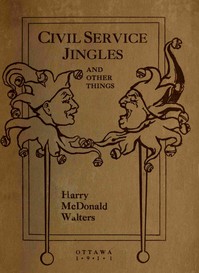
Civil service jingles and other things — Text and Context
Edition facts
The source record for Civil service jingles and other things — Text and Context measures this digital text at 28,154 words, 2 hr 3 min estimated reading time, and 51 detected text sections.
The text analysis averages about 22.7 words per sentence, while the detected sections provide another way to judge how the source is divided.
Project Gutenberg metadata also associates the work with “Canadian wit and humor,” connecting these edition facts with the source record’s subject description.
Read the complete public-domain text at its original source.
Read on Project GutenbergHarry McDonald Walters' Civil Service Jingles and Other Things (1911) opens with a preface by J. L. Payne, who praises the author's 'bright and observing mind' and his 'entertainingly satirical shape.' The collection's title piece, 'The Song of the Extra Clerk,' immediately establishes a tone of wry complaint: the extra clerk does most of the work while the permanent staff 'gets all of the credit.' Walters uses a jaunty, sing-song meter to mock the hierarchy and pay disparities within the Canadian civil service, complete with footnotes that wink at the reader—'Pronounce as written CLERK'—and a self-deprecating joke about a 1902 parliamentary reference.
Satirical Verse and Bureaucratic Grievances
Walters' 'jingles' are not mere light verse; they are pointed critiques of workplace inequity. In 'The Song of the Extra Clerk,' the speaker contrasts the 'poor Extra Clerk' with the 'Permanent Staff,' who 'in its sleeve has reason to laugh.' The poem's structure—a series of limerick-like stanzas—mirrors the repetitive, cyclical nature of bureaucratic complaint. Walters employs a colloquial voice ('ye ken,' 'don't you see?') that invites the reader into an insider's joke, while the footnotes add a layer of meta-commentary. For instance, a note on 'Permanent Clerks' instructs the reader to 'Pronounce Clerk as in the “upper suckles,”' highlighting class distinctions even in pronunciation. The humor is dry and self-aware, as when the extra clerk notes that if they got drunk like the permanents, they'd be fired and lose their 'so much' a day. This blend of wit and grievance suggests Walters wrote for an audience intimately familiar with the civil service's petty frustrations.
Parable and Prose: Gastonio and the Art of Exaggeration
The prose piece 'The Parable of Gastonio and How He Saved His Bacon' shifts from verse to a mock-biblical style. The opening—'And Gastonio was sore afraid; he quaked with fear so that his knees wobbled, and his face paled even to the brown wart on his nose'—parodies the cadence of scripture while introducing a farcical crisis. The narrator's voice is arch and detached, describing Gastonio's terror with exaggerated physical detail. The parable's title promises a moral lesson, but the excerpt suggests a comic rather than didactic outcome. Walters' prose here is more ornate than his verse, using repetition ('And he lifted up his voice, and it was a heavy voice') and hyperbolic imagery to create a burlesque of biblical narrative. This stylistic contrast within the collection demonstrates Walters' range, moving from the tight rhyme of the jingles to the loose, parodic rhythms of parable.
Domestic Satire: The Revolt of Mrs. Johns
A later prose excerpt presents a domestic drama: Mrs. Johns leaves her husband after a quarrel, only to return after eight days of reflection. Walters renders her internal shift with psychological precision: 'She discovered that living with mother was not half as pleasant as living with Johns; that home was not what it used to be.' The narrative voice is sympathetic but wry, noting that Mrs. Johns 'surprised herself saying aloud, “Poor Jack.”' The climax—Mrs. Johns finding her husband smoking on the best sofa—turns on a trivial object (sofa pillows) that becomes a symbol of marital negotiation. Johns' response—'What does anything matter, dear, if two people love each other?'—advocates for mutual tolerance, but the scene's humor undercuts any sentimentality. Walters balances the wife's perspective with the husband's, avoiding easy villainy. The prose is more naturalistic than the parable, with dialogue that feels lived-in: 'You, Florry! Have you come back to hubby to be a good girl?'
Voice and Audience: The Civil Servant as Insider
Throughout the collection, Walters assumes a knowing reader. The footnotes in 'The Song of the Extra Clerk'—'Reference D. P. W.' (likely Department of Public Works) and 'This joke was first made in 1902'—treat the poems as inside jokes for fellow bureaucrats. The preface by J. L. Payne, himself a civil servant, reinforces this: the book is meant for 'the idle hour,' not the study. Walters' diction oscillates between formal and slangy, as when the extra clerk describes himself as 'riff-raff.' This code-switching mirrors the social tensions he satirizes. The domestic sketch, while less explicitly about government work, shares the same concern with power dynamics and unspoken rules. Walters' authorial choices—the use of footnotes, the mock-biblical prose, the shift from verse to narrative—suggest a writer who is both entertainer and critic, using humor to expose the absurdities of institutional life without resorting to bitterness.
Readers approaching Civil Service Jingles and Other Things should expect a hybrid work: part verse, part prose, part satire, part domestic comedy. Walters' strength lies in his ear for the absurdities of daily routine—whether in the office or at home. The collection rewards attention to its formal playfulness, from the limerick-like jingles to the parodic biblical cadences. While the excerpts offer only a sample, they reveal a writer who uses humor to probe the gap between official roles and human realities. This is not a book of lofty ambition but of sharp, affectionate observation.
I keep thinking about that old civil service satire, how the bureaucracy’s own jingles become a kind of inner hell. It reminded me, strangely, of Divine Comedy, Cary's Translation, Hell — A Closer Reading—not for punishments, but for that quiet, endless circling in the same small rooms. There’s a familiar ache in both, a tired laugh at rules that never let you leave.
There are no reviews for this eBook.
Record your reading impressions
A brief reflection can help important ideas stay with you longer.