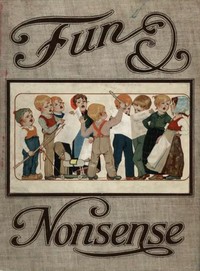
Fun and Nonsense — Text and Context
Edition facts
Before opening Fun and Nonsense — Text and Context, the edition data offers a quick orientation: 3,739 words, 17 min estimated reading time, and 1 detected text section.
The text analysis averages about 21.9 words per sentence, while the detected sections provide another way to judge how the source is divided.
Project Gutenberg metadata also associates the work with “Children's poetry,” connecting these edition facts with the source record’s subject description.
Read the complete public-domain text at its original source.
Read on Project GutenbergWillard Bonte's Fun and Nonsense opens with an invitation: the introductory quatrain presents Fun and Nonsense as "merry little twins" who bring "the Grins" as friends. This framing establishes the collection's playful, domestic logic. The poems that follow are populated by kitchen utensils, foodstuffs, and household items—Chocolate Drop the Barber, a lettuce who loses his head, a pocketbook who is "daft" about money. Each verse is a tight four- or six-line scene, often built around a single pun or ironic reversal.
A World of Animated Objects
The poems consistently treat inanimate or edible items as characters with human concerns. The barber is a chocolate drop; the barber pole is a stick of peppermint. A whitewash brush complains that his hair "still stays pompadour" despite his efforts. Old Mr. Match scratches his head and lights up with a smile. The conceit is sustained across the collection: a pocketbook is stingy, a key is haughty, a yeast-cake is a doctor who promises a roll will rise. This consistent personification gives the book a cohesive internal logic, even as the scenes shift abruptly from a cornfield conversation to a sailor made of pretzel.
Puns and Wordplay as Structural Engine
Nearly every poem hinges on a pun or double meaning. In "The Refusal," Lady Cracker scorns Judge Wafer because he is "lacking in dough"—both pastry and money. Dr. Key's answer to the Monkey Wrench is "No Monkey-shines for me." The greedy little pitchers have "big ears," a proverb literalized. The twins are scissors, "cutting as ever" and "sharp." These wordplays are not decorative; they are the point of each poem. The humor depends on the reader recognizing the dual meanings, and the brevity of the verses ensures the pun lands quickly.
Movement Between Scenes and Characters
The collection's structure is episodic, with no narrative thread connecting the poems. Each verse is a self-contained vignette, and the characters do not reappear. The table of contents lists 20 titles, from "The Barber" to "The Wise Pen," suggesting a deliberate sequence. The opening invitation and the closing poem ("The Wise Pen") may frame the collection, but the middle poems jump from a miser to a doctor to a sailor to a cornfield conversation. This lack of continuity mirrors the "nonsense" tradition, where surprise and incongruity are valued over plot. The reader moves from one absurd situation to the next without transition.
Recurring Images of Food and Tools
Two categories dominate the imagery: food items and household tools. Food characters include Chocolate Drop, Lady Cracker, Judge Wafer, lettuce, pumpkin, yeast-cake, roll, pretzel, and corn. Tools and objects include whitewash brush, match, pocketbook, key, monkey wrench, scissors, and pen. This pairing creates a world where the kitchen and the workshop coexist. The poems often mix these categories: a sailor is a pretzel, a doctor is a yeast-cake. The consistency of these image clusters gives the collection a recognizable flavor, even as the individual poems remain distinct.
Bonte's Fun and Nonsense rewards attention to its wordplay and the logic of its miniature world. The poems are best read aloud, where the puns and rhythms become clear. Readers may notice how the collection balances familiar nursery-rhyme structures with unexpected twists. The brevity of each verse invites rereading, and the absence of a continuous story allows the book to be opened at any page.
I remember my grandmother’s kitchen, its chipped teapots and spoons, and how Willard Bonte’s verses seemed to wake those quiet objects into life. Reading his little world of animated tools, I felt the same gentle warmth I once found in the lyrical, everyday joys of Herrick, where a daffodil or dish could hold eternity. A Selection from the Lyrical Poems of Robert Herrick — Inside the Classic lingered in me that way, a soft echo of lingering gladness.
There are no reviews for this eBook.
What was your reading experience?
Capture what you thought, learned, and would like to remember.