Horæ Nauseæ — Background and Themes
Edition facts
Horæ Nauseæ — Background and Themes can be approached with a clearer sense of reading commitment from its source measurements: 7,896 words, 35 min estimated reading time, and 20 detected text sections.
The text analysis averages about 21.5 words per sentence, while the detected sections provide another way to judge how the source is divided.
Project Gutenberg metadata also associates the work with “English poetry -- 19th century,” connecting these edition facts with the source record’s subject description.
Read the complete public-domain text at its original source.
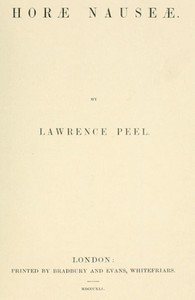
Read on Project GutenbergLawrence Peel’s Horæ Nauseæ (1841) announces its satirical intent in the title alone, but the structure of the volume is its first joke: translations from Spanish poets and Horace sit alongside original comic pieces, with no clear dividing line between the earnest and the absurd. The book moves from Gil Polo’s complaint that “Love is not blind, but I alone” to Quevedo’s meditation on a crumbling ancestral sword, then to a dialogue in which a tallow chandler cannot stop comparing the moon to a lamp. This juxtaposition of high sentiment and low material is the collection’s central device.
Translations as a Frame for Parody
The opening translations are not straightforward. Peel selects Spanish poets who dwell on decay, death, and disillusionment: Quevedo’s speaker sees “my native town decay” and a sword “eaten into its corroded blade”; Argensola asks why “fraud ascends the judgment-seat.” These somber pieces establish a voice of moral gravity that the later original poems undercut. The Horace translations—Odes I.iii, I.v, I.ix, and III.xxix—introduce classical restraint, but the volume’s structure ensures they are read as straight men to the farce that follows. The effect is cumulative: the reader cannot be sure whether the translator is sincere or already winking.
The Tallow Chandler’s Cosmic Shop Talk
In “A Matrimonial Dialogue and Marine Eclogue,” Peel’s most sustained comic scene, Mr. Adipocire—a tallow chandler—cannot stop translating nature into his trade. He praises the moon as “Night hang her silver lamp,” then corrects himself to “tapers,” then “burn.” His wife’s exasperated interruptions (“Lamp!” “Tapers, for shame!”) form a running gag. The poem’s structure is a dialogue in which one speaker consistently misapplies the vocabulary of his profession to the sublime. The joke depends on the reader recognizing the gap between poetic convention and commercial reality, a gap Peel exploits by having Mr. Adipocire invoke Shakespeare and Argand lamps in the same breath.
Recurring Images of Decay and Domesticity
Across the collection, images of physical decay recur: Quevedo’s “corroded blade,” the “black and Time-dishonour’d wall,” and the “shorten’d staff” that yields under pressure. In the original pieces, decay shifts from the monumental to the domestic. The doctor in “The Doctor Without a Soul” is baffled by weeping ladies who find “the earth, sea, sky, sun, shade, and flowers, / Are agonising quite.” The tallow chandler’s wife threatens gout as a consequence of staying out too long. Peel repeatedly brings grand poetic tropes—death, time, nature—into collision with petty, bodily, or commercial realities, creating a world where every high sentiment is undercut by a physical detail.
Abrupt Shifts in Voice and Register
The volume’s structure depends on sudden changes in tone. A translation of Quevedo’s meditation on mortality is followed by “A Fable”; the Horace odes are followed by “Ode to Harris,” presumably a mock-heroic address. The most extreme shift occurs within “The Doctor Without a Soul,” where the narrator moves from a description of a pastoral landscape to a dialogue with two weeping ladies who speak in a deliberately artificial, romantic idiom. The doctor’s literal-minded responses—“The glass is rising; to repine / Seems rude unthankfulness”—highlight the gap between his world and theirs. Peel does not resolve these clashes; he lets them stand as evidence of irreconcilable ways of seeing.
Readers approaching Horæ Nauseæ should watch for the way Peel uses the physical book’s structure—translations first, then originals—to set up expectations he then subverts. The recurring images of decay, the domestic interruptions of the sublime, and the abrupt shifts in register are not flaws but the point. This is a collection that asks to be read as a performance of incongruity, not as a unified statement.
I found myself thinking of the old 1841 volume's ragged shifts—decay and domestic squabbles tucked beside Horace. Its worn, uneven spirit reminded me of another collection, one I once leafed through slowly: The Poems of Henry Kendall With Biographical Note by Bertram Stevens — Edition Insights. There, too, a quiet ache of landscapes and loss, gentler, but the same sense of words surviving their own melancholy.
There are no reviews for this eBook.
Record your reading impressions
A brief reflection can help important ideas stay with you longer.