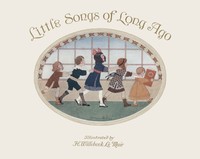
Little Songs of Long Ago: More Old Nursery Rhymes — Reading Notes
Edition facts
The source record for Little Songs of Long Ago: More Old Nursery Rhymes — Reading Notes measures this digital text at 6,520 words, 29 min estimated reading time, and 33 detected text sections.
The text analysis averages about 17.6 words per sentence, while the detected sections provide another way to judge how the source is divided.
Project Gutenberg metadata also associates the work with “Children's poetry,” connecting these edition facts with the source record’s subject description.
Read the complete public-domain text at its original source.
Read on Project GutenbergThe thirty rhymes in Little Songs of Long Ago are arranged by Alfred Moffat with harmonized tunes, but the text alone reveals a deliberate patterning of language. Many rhymes rely on incremental repetition—verses build by adding new lines while repeating earlier ones, as in “Dame get up and bake your pies,” where each stanza introduces a new question while the refrain “On Christmas Day in the morning” stays fixed. This structure creates a steady, predictable rhythm that contrasts with the sudden shifts in subject matter, from baking pies to dying ducks.
Repetition as a Structural Anchor
Several rhymes use repetition not just for memorability but as a formal device. In “Young lambs to sell,” the opening line is stated four times before any variation appears, establishing a chant-like cadence. The phrase “Two for a penny, eight for a groat” then introduces a numerical puzzle, breaking the pattern briefly before returning to the refrain. Similarly, “Dance a baby diddy” repeats the title phrase twice in its four lines, with the middle lines offering a concrete image—sitting in a lap, giving pap—that grounds the abstract dance. This alternation between repetition and new information controls the pace, slowing the reader during refrains and quickening during narrative details.
Abrupt Tonal Shifts and Narrative Voice
The collection contains rhymes that pivot sharply from playful to menacing, often within a single stanza. “Goosey, goosey, gander” begins with a wandering question and ends with a violent act: throwing an old man down the stairs. The voice remains matter-of-fact, never commenting on the morality of the action. In “A little cock-sparrow,” the threat of being made into stew is presented in the same cheerful meter as the bird’s chirruping. The sparrow’s refusal—“Oh, no!”—and quick escape provide a rare moment of agency. These shifts in tone are not signaled by changes in language; the same simple vocabulary and regular rhythm carry both comfort and threat, leaving the reader to adjust pace instinctively.
Varied Line Lengths and Rhythmic Variation
While many rhymes use short, uniform lines, a few introduce longer, more complex structures. “I had a little nut tree” consists of six lines with a consistent meter, but the final couplet—“The King of Spain’s daughter / Came to visit me”—lengthens the narrative arc, creating a pause before the return to the nut-tree refrain. “Sleep, baby, sleep” uses a lullaby rhythm with repeated imperatives and a closing couplet that mirrors the opening, producing a circular, soothing pace. In contrast, “The north wind” (partially excerpted) likely employs a more urgent meter. These variations prevent the collection from becoming monotonous, offering readers a change in pacing that mirrors the emotional range of the rhymes.
Readers may find it useful to read the rhymes aloud, paying attention to how the repeated phrases and sudden tonal shifts affect delivery. The collection rewards attention to the interplay between the fixed musical settings and the flexible spoken rhythms of the text. Observing which rhymes use incremental repetition versus abrupt narrative turns can reveal the craft behind these seemingly simple verses.
There are no reviews for this eBook.
Take a moment to reflect on this book
Create a short personal record of your experience with this book.