Mirth and metre — Context and Discussion
Edition facts
Mirth and metre — Context and Discussion can be approached with a clearer sense of reading commitment from its source measurements: 29,695 words, 2 hr 10 min estimated reading time, and 17 detected text sections.
The text analysis averages about 29.8 words per sentence, while the detected sections provide another way to judge how the source is divided.
Project Gutenberg metadata also associates the work with “English wit and humor,” connecting these edition facts with the source record’s subject description.
Read the complete public-domain text at its original source.
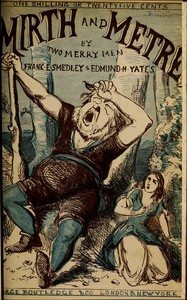
Read on Project GutenbergFrom its opening preface, Mirth and Metre announces itself as a deliberate imitation of the Ingoldsby Legends, a confession that the authors turn into a playful defense. The verse that follows is crowded with parenthetical asides, sudden shifts in rhyme and rhythm, and a narrator who cannot resist interrupting his own story. In the excerpt from “Maude Allinghame,” for instance, the herald’s predicament is undercut by a string of comic digressions—on the Middle Ages, on a character’s “no ‘call’ to assist in this felo de se”—that keep the tone buoyant even when the plot turns threatening. The result is a performance of wit that values energy over polish, and that asks the reader to share in the joke.
A Self-Conscious Imitation
The preface directly addresses the charge of imitation, conceding that the authors have taken the Ingoldsby Legends as a model. They argue that a writer may “embody his own thoughts and feelings in a form which experience has approved” without being a servile copyist. This defensive yet cheeky tone sets the pattern for the poems: they are full of knowing nods to the reader, such as the aside “(bad grammar, you know, / When it’s written by Shakespeare no longer is so)” in “Maude Allinghame.” The narrators frequently step out of the story to comment on their own lines, creating a sense of complicity with the audience. The result is a collection that wears its influences on its sleeve while trying to carve out its own comic identity.
Shifting Meters and Comic Timing
The verse in Mirth and Metre is metrically restless. Lines vary wildly in length, and rhymes come in unexpected clusters. In the excerpt, a passage of anapestic tetrameter suddenly contracts to a two-beat line (“Howe’er this may be, / Our herald felt he”), then expands again. This irregularity serves the comic timing: the narrator can speed up for a list of misfortunes (“When a bill’s coming due, and you’ve no chance of meeting it; / When old Harry’s to pay, and the pitch has no heat in it”) and then slow down for a punchline. The effect is conversational, as if the poet is making it up as he goes along. The frequent use of dashes and parentheses reinforces this improvisational feel, inviting the reader to share in the spontaneity.
Mock-Heroic Threats and Domestic Details
The poem “Maude Allinghame” juxtaposes grand, chivalric language with mundane, even anachronistic details. The herald De Rodon threatens the Countess Yolenta with the loss of her hand, but the scene is undercut by the revelation that the “six mutes in black armour” are actually “six laughing girls with bright mischievous eyes.” Later, Yolenta’s flight involves a comically detailed account of servants demanding wages and board-wages, with the butler growing “crusty / As his oldest port wine.” This blend of high and low—the axe and the packing of a “leathern valise”—is a hallmark of the Ingoldsby style, and the authors lean into it heavily. The humor depends on the reader recognizing the gap between the epic frame and the trivial realities that keep intruding.
Mirth and Metre rewards a reader who enjoys watching a poet juggle multiple tones at once. The poems are best approached not as sustained narratives but as performances: listen for the changes in pace, the sudden shifts from galloping anapests to clipped lines, and the narrator’s habit of breaking character to share a joke. The illustrations by William McConnell, though not reproduced here, were likely part of the same playful spirit. Treat each poem as a self-contained comic turn, and the collection’s unevenness becomes part of its charm.
There’s a curious warmth in old books that laugh at themselves, like that Smedley and Yates collection—its puns and asides feel like a friend nudging you mid-story. It reminded me, oddly, of The Poems of Schiller — Suppressed poems — Reading Notes, where even the unfinished lines carry a quiet ache. Both lingered with me, differently, long after I set them down.
There are no reviews for this eBook.
Take a moment to reflect on this book
Create a short personal record of your experience with this book.