Nonsense for old and young — Themes and Context

(0 User reviews)   148
Field, Eugene, 1850-1895, Frohn, John C. [Illustrator] Project Gutenberg 2024 Not confirmed
American wit and humor; Humorous poetry, American Readers of public-domain and historical texts
Project Gutenberg digital edition en

Edition facts

Words 9,098
Reading time 40 min
Text sections 2

Nonsense for old and young — Themes and Context can be approached with a clearer sense of reading commitment from its source measurements: 9,098 words, 40 min estimated reading time, and 2 detected text sections.

The text analysis averages about 13.6 words per sentence, while the detected sections provide another way to judge how the source is divided.

Project Gutenberg metadata also associates the work with “American wit and humor,” connecting these edition facts with the source record’s subject description.

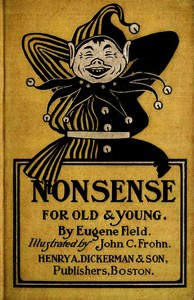
Eugene Field's 1881 Tribune Primer sketches, repurposed as adult nonsense, parody children's reading primers with deadpan satire of politics, journalism, and domestic life, illustrated by John C. Frohn.
Share

Read the complete public-domain text at its original source.

Read on Project Gutenberg

Eugene Field's Nonsense for Old and Young recycles 94 of his Denver Tribune “Primer” sketches from 1881, adding new illustrations by John C. Frohn. The pieces mimic early reading lessons: short declarative sentences, heavy capitalization, and a mock-serious tone. But the subject matter—boodle politicians, sleeping policemen, a mother who refuses her son the moon—is anything but childlike. Field’s deadpan delivery turns the primer format into a vehicle for satire aimed squarely at adults.

The Primer as Political Sandbox

Several sketches target Colorado politics with a local specificity that the publishers admit may have faded. In “A Political Object Lesson,” a Democratic candidate stands still while a Republican would be running; Democratic candidates “can not Run. They do not even Walk.” The joke depends on knowing that Colorado’s early politics were fiercely competitive. “Hot Air vs. Cold Water” personifies a windmill as a former Democratic politician now reduced to hauling water for a living, concluding that “Any Kind of Honest Labor is awful rough on a Democrat.” These pieces treat political affiliation as a kind of congenital laziness or hot air—a stance that would have landed differently in 1881 than today.

Deadpan Violence and Domestic Chaos

Field’s humor often turns on sudden, understated violence. In “A Portrait of a Lady,” the “Amiable and Accomplished Wife” is “Walloping him with the Rolling Pin” while her husband is “as Full as a Tick.” “One Autumn Night” describes a lover’s serenade interrupted by a bulldog bite: “A nip, a grip, and then a pang!” The poem ends with a “canine quivering with delight.” Even the George Washington anecdote in “The Truth About the Cherry Tree” twists the myth: young George admits the deed but gets “One in the Neck for using Bad Grammar.” The humor comes from the gap between the primer’s innocent tone and the casual cruelty of the content.

Rhythm and Compression in the Short Forms

Field’s prose sketches rely on abrupt, staccato sentences that mimic a child’s reading book but deliver adult punchlines. “Would You?” asks if a picture of a boodle politician is beautiful, then notes “The left Eye is Closed. It must be Tired.” The deadpan logic is absurd. The verse pieces, like “An Ode to a Cat,” use clipped couplets (“A hungry Cat— / A foolish Rat”) to build a swift, almost mechanical narrative of predation. The brevity forces each word to carry weight; the humor depends on timing and the unexpected shift from primer-style simplicity to cynical or violent payoff.

Because the excerpts are limited to roughly a third of the original 162 sketches, the full range of Field’s targets—and the cumulative effect of the primer format—remains partly obscured. Readers should approach the collection as a period artifact: a newspaper humorist’s experiment in repurposing a children’s form for adult satire, with local references that may require footnotes. The illustrations by John C. Frohn add a visual layer that the text alone cannot convey.

That afternoon, the rain ticking against the window, I kept laughing at the absurd seriousness of old primers turned upside down. The deadpan satire felt oddly gentle, a reminder that even our most earnest structures are just stories. It made me quiet, and in that quiet, I found myself reaching for The Poems of Henry Kendall With Biographical Note by Bertram Stevens — Edition Insights—a different century’s voice, but the same patient longing for something true beneath the words.

There are no reviews for this eBook.

0
0 out of 5 (0 User reviews )

Add a Review

Your Rating *
There are no comments for this eBook.

Reader reflection

Take a moment to reflect on this book

Create a short personal record of your experience with this book.

Your progress 0 / 10
1

Which reading stage best describes you?

2

Did this book hold your interest?

3

Would you recommend this book to another reader?

4

Did the language feel accessible?

Related eBooks