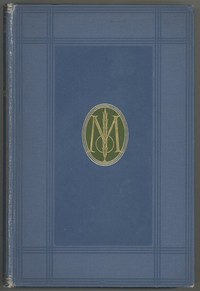
The Poetical Works of Oliver Wendell Holmes — Volume 01: Earlier Poems (1830-1836) — Key Ideas to Explore

(0 User reviews)   2130
Holmes, Oliver Wendell, 1809-1894 Project Gutenberg 2004 Not confirmed
American poetry Readers of public-domain and historical texts
Project Gutenberg digital edition en

Edition facts

Words 14,725
Reading time 65 min
Text sections 2

This digital edition of The Poetical Works of Oliver Wendell Holmes — Volume 01: Earlier Poems (1830-1836) — Key Ideas to Explore is described by source-level measurements including 14,725 words, 1 hr 5 min estimated reading time, and 2 detected text sections.

The text analysis averages about 32.4 words per sentence, while the detected sections provide another way to judge how the source is divided.

Project Gutenberg metadata also associates the work with “American poetry,” connecting these edition facts with the source record’s subject description.

This volume collects Oliver Wendell Holmes's earliest published poems (1830–1836), including 'Old Ironsides' and 'The Last Leaf,' with a prefatory poem reflecting on poetic ambition and the tension between youthful freshness and mature craft.
Share

Read the complete public-domain text at its original source.

Read on Project Gutenberg

Oliver Wendell Holmes opens this collection with a prefatory poem, 'To My Readers,' dated 1862, that frames the earlier works as 'ruder songs' possessing 'freshness which the new have lost.' This self-deprecating gesture sets a reflective tone, as Holmes muses on the transience of poetic fame: 'I read oblivion in its date, / And Finis on its title-page.' The volume gathers poems from 1830 to 1836, a period when Holmes was in his twenties, and includes the celebrated 'Old Ironsides,' which he wrote in response to a newspaper paragraph about scrapping the frigate Constitution. The poems range from occasional pieces to metrical experiments, revealing a young poet testing his voice against established forms.

The Poet's Self-Conscious Beginning

The prefatory poem 'To My Readers' is not merely an apology but a subtle manifesto. Holmes contrasts the 'opening leaf' of youth with the 'autumn thistle's silvery down' of later years, suggesting that early work has a vitality that maturity cannot replicate. He questions the durability of books: 'How long before your blue and gold / Shall fade and whiten in the dust?' This anxiety about legacy recurs in the volume's longer pieces. In 'Poetry: A Metrical Essay,' Holmes examines the poet's craft, describing 'our grating English, whose Teutonic jar / Shakes the racked axle of Art's rattling car.' The metaphor is characteristically playful yet precise, revealing a mind attuned to the mechanical difficulties of verse. He acknowledges that 'all are poets' in feeling, but only the 'saints on high' can fully express what words deny—a humble admission that undercuts any grandiosity.

Occasional Poems and Public Voice

'Old Ironsides' exemplifies Holmes's ability to turn a public occasion into enduring verse. Written to protest the scrapping of the USS Constitution, the poem adopts a martial tone: 'Ay, tear her tattered ensign down!' Yet the poem's power lies in its shift from defiance to elegy, imagining the ship's final moments. Other occasional pieces, like 'The Comet' and 'The Music-Grinders,' show Holmes experimenting with satire and light verse. 'The Last Leaf,' a portrait of an aged Revolutionary War veteran, blends pathos with wry observation: 'The mossy marbles rest / On the lips that he has prest.' These poems reveal a poet comfortable with varied registers—from the solemn to the comic—and a keen eye for the peculiarities of New England life. The volume's shorter lyrics, such as 'To an Insect' and 'My Aunt,' demonstrate a playful intimacy, often addressing trivial subjects with mock-heroic gravity.

Metrical Range and Formal Experiment

Holmes's early work displays a conscious engagement with poetic form. In 'Poetry: A Metrical Essay,' he catalogs different meters: the 'proud heroic' with its 'pulse-like beat,' the 'sweet Spenserian' that 'sweeps gently onward,' and the 'glittering lyric' that 'bounds elastic by.' This taxonomy is not mere pedantry; it reflects Holmes's own practice. The poems in this volume employ a variety of stanza forms and rhyme schemes, from the quatrains of 'Old Ironsides' to the octosyllabic couplets of 'The Dorchester Giant.' Holmes's ear for rhythm is evident in lines like 'The sweet Spenserian, gathering as it flows, / Sweeps gently onward to its dying close,' where the meter mimics the sense. Yet he also admits the limitations of language: 'The flowering moments of the mind / Drop half their petals in our speech.' This tension between formal control and expressive inadequacy gives the collection a reflective, almost melancholic undercurrent.

Readers approaching this volume should attend to the interplay between Holmes's public and private voices. The occasional poems, rooted in specific events, gain resonance from the prefatory frame that questions their permanence. The metrical essay offers a key to understanding Holmes's craft, but the shorter lyrics often reveal more about his developing sensibility. As a record of a young poet finding his footing, this collection rewards attention to its formal variety and self-aware commentary on the limits of verse.

That afternoon, rain blurred the window as I lingered over Holmes’s early verses—his fresh, unpolished ambition felt almost audible. Later, I fumbled for a related edition and found myself in Poems — Volume 1 — Context and Discussion, its quieter footnotes easing me into another poet’s first attempts. The drizzle never stopped, but the conversation between those pages felt unhurried and warm.

There are no reviews for this eBook.

0
0 out of 5 (0 User reviews )

Add a Review

Your Rating *
There are no comments for this eBook.

Reader reflection

How will you remember this book?

Save your reaction, strongest insight, and memorable passage.

Your progress 0 / 10
1

Have you finished this book?

2

How much did you enjoy the reading experience?

3

Would you encourage someone else to read it?

4

How demanding did the text feel?

Related eBooks