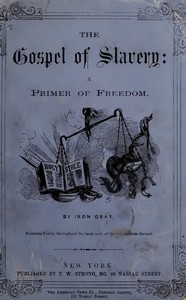
The Gospel of Slavery: A Primer of Freedom — Themes and Context
Edition facts
The catalog record for The Gospel of Slavery: A Primer of Freedom — Themes and Context provides practical reading context through 7,301 words, 32 min estimated reading time, and 2 detected text sections.
The text analysis averages about 21.9 words per sentence, while the detected sections provide another way to judge how the source is divided.
Project Gutenberg metadata also associates the work with “Slavery -- United States,” connecting these edition facts with the source record’s subject description.
Read the complete public-domain text at its original source.
Read on Project GutenbergPublished in 1864 under the pseudonym 'Iron Gray,' The Gospel of Slavery: A Primer of Freedom adopts the familiar structure of an alphabet book to mount a pointed abolitionist argument. Each letter introduces a keyword—A for Adam, B for Bloodhound, C for Cotton—followed by a short poem and a prose passage that expands the critique. The work opens by invoking the Declaration of Independence, quoting its assertion that 'all men are created equal' and challenging readers to reconcile that principle with the institution of slavery. This blend of verse and editorial commentary gives the primer a dual voice: one lyrical, the other polemical.
Alphabet as Argument
The book’s alphabetical structure is not merely a mnemonic device but a deliberate rhetorical strategy. Each letter introduces a term central to the slavery debate, from 'A stands for Adam' (establishing a biblical basis for human equality) to 'X stands for Cross' (invoking Christian conscience). The poems are compact, often ending with a pointed question: 'Then how comes dominion of brother by brother? / Or how can the one be the lord of the other?' The prose sections that follow each poem provide historical or contemporary evidence, such as references to Southern newspaper advertisements for bloodhounds used to track fugitive slaves. By alternating verse and prose, the author creates a rhythm that moves from emotional appeal to factual indictment.
Voices of Authority Quoted
Throughout the primer, Thomas incorporates quotations from both pro-slavery and anti-slavery figures, using their own words to expose contradictions. For example, under 'C stands for Cotton,' he cites a Rebel leader, Dr. Smyth, who declares that the 'Atheistic Red Republican doctrine of the Declaration of Independence' is the root of the conflict. Under 'U stands for Union,' he quotes Alexander H. Stephens praising the U.S. government as 'the best and freest government'—a statement made in January 1861, just before the Civil War erupted. These quotations are not merely decorative; they serve as exhibits in the author’s case, showing that even slavery’s defenders acknowledged the nation’s founding ideals while working to undermine them.
The Primer’s Moral Calculus
Thomas repeatedly frames slavery as a moral and religious failing, not merely a political one. Under 'W stands for Woman,' he describes how enslaved mothers are denied the status of wife and their children are sold, contrasting this with the claim of Southern ladies that they 'care as tenderly for slave mothers.' The rejoinder is sharp: 'Northern ladies do not afterwards sell the baby!' Under 'X stands for Cross,' he argues that slavery 'crucify Christ' anew by ignoring the principle that Christ 'died for all, tasted death for every man.' The primer thus insists that the sin of slavery cannot be separated from Christian duty, and that economic arguments for the institution are ultimately blasphemous.
From Primer to Polemic
While the alphabet format might suggest a children’s book, the content is clearly aimed at adults. The poems use simple rhyme and meter, but the prose passages are dense with political and theological argument. Under 'V stands for Victory,' Thomas declares that the first gun fired on Fort Sumter was 'the beginning of the end' of slavery, and he calls for the flag to be 'vindicated and exalted in righteousness, though it be through blood and fire.' This shift from educational tool to wartime rallying cry reflects the book’s dual purpose: to instruct and to agitate. Readers should note that the primer does not present a neutral overview but a passionate, partisan intervention in the national debate.
The Gospel of Slavery rewards readers who attend to the interplay between its poetic and prose sections. The alphabet structure invites comparison across entries—how does the treatment of 'C for Cotton' relate to 'U for Union'? The quotations from contemporary figures also merit scrutiny, as they reveal the rhetorical strategies of both sides. This is not a work of detached history but a document of its moment, shaped by the urgency of war and the conviction that the primer form could serve the cause of freedom.
Holding this alphabet primer, I recalled my grandfather’s old spelling book, its margins filled with his slow pencil. He taught me that letters carry weight. Reading The Gospel of Slavery, I felt that same quiet gravity. It reminded me of the hushed winter evenings spent with Plet: A Christmas Tale of the Wasatch — A Closer Reading, where every simple word held a deeper, unspoken ache.
There are no reviews for this eBook.
What was your reading experience?
Capture what you thought, learned, and would like to remember.