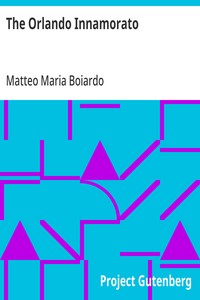
The Orlando Innamorato — A Reader’s Guide

(0 User reviews)   721
Rose, William Stewart, 1775-1843 [Translator], Boiardo, Matteo Maria, 1441?-1494, Berni, Francesco, 1498?-1535 [Adapter] Project Gutenberg 2018 Not confirmed
Roland (Legendary character) -- Romances; Epic poetry, Italian -- Translations into English; Epic poetry, Italian -- Adaptations Readers of public-domain and historical texts
Project Gutenberg digital edition en

Edition facts

Words 54,235
Reading time 236 min
Text sections 5

The Orlando Innamorato — A Reader’s Guide can be approached with a clearer sense of reading commitment from its source measurements: 54,235 words, 3 hr 56 min estimated reading time, and 5 detected text sections.

The text analysis averages about 28.9 words per sentence, while the detected sections provide another way to judge how the source is divided.

Project Gutenberg metadata also associates the work with “Roland (Legendary character) -- Romances,” connecting these edition facts with the source record’s subject description.

William Stewart Rose's prose translation of Boiardo's chivalric epic, interspersed with verse extracts, follows Orlando's loves and battles. The edition includes the translator's preface and notes, revealing his method of condensing the original while preserving its humorous and romantic tone.
Share

Read the complete public-domain text at its original source.

Read on Project Gutenberg

William Stewart Rose presents this prose translation of Matteo Maria Boiardo's Orlando Innamorato as a necessary prologue to Ariosto's Orlando Furioso, a work he had earlier undertaken. Rose's version is not a line-for-line rendering but a compendious prose narrative interspersed with verse extracts in the original stanza form. In his introduction, he explains his method: he sought to avoid giving a false impression of the poem's tone by infusing it with extraneous pleasantry, as he felt earlier translators of similar romances had done. The result is a work that aims to balance fidelity to Boiardo's humour with a clear, readable style.

The Translator's Balancing Act

Rose's preface reveals a careful negotiation between condensation and preservation. He notes that the Innamorato is 'in a great measure a humourous work,' and he is wary of distorting that character. His solution is to translate the bulk of the narrative into prose, but to render key passages—such as Brandimart's lament over Flordelis—in verse, using the same stanza form as the original. This hybrid approach allows him to retain the poetic texture of Boiardo's most dramatic moments while keeping the story moving. Rose also acknowledges his debt to earlier adapters like Tressan and his friend George Ellis, but he distinguishes his own project by insisting on a more restrained tone. The reader is thus presented with a text that is self-consciously a translation, one that wears its compromises openly.

Patterns of Fortune and Lament

A recurring motif in the excerpts is the character's direct address to Fortune, often in moments of extreme distress. Brandimart's apostrophe—'Thou took'st me, Fortune, from a royal dome'—is a sustained complaint that recapitulates his life's misfortunes: abduction, slavery, a false hope of freedom, and the loss of his beloved. This pattern of blaming Fortune appears also in the translator's dedicatory sonnet, where Morgana is described as 'the type of Fortune, who, flying from her garden into a wilderness, is taken by Orlando.' The poem's structure thus intertwines personal grievance with allegorical action. The damsel's tale of the foot-race and the golden apples (an echo of Atalanta) reinforces the theme of cunning versus fate, as the old man Folderico outwits the princess by a trick that mirrors classical myth.

Violence and Rescue in the Forest

The excerpts depict a world where violence erupts suddenly and rescue is often partial. Flordelis is carried off by a hermit to a cave, only to be saved when a lion attacks the ravisher; but her escape is brief, as she then falls into the hands of 'a hairy savage' who binds her to a tree. The sequence is typical of the poem's episodic structure: perils follow one another without pause, and characters rarely enjoy lasting safety. Orlando and his companions move through this landscape as agents of temporary relief, but the narrative's rhythm—capture, escape, recapture—suggests a world governed by chance and cruelty. The damsel's own story, told to Brandimart, mirrors this pattern: she is a princess who tries to control her fate through a race, only to be outmaneuvered. The forest setting, with its caves, lions, and savages, becomes a stage for these repeated trials.

Readers approaching this edition should note that Rose's translation is a selective rendering, not a complete version of Boiardo's poem. The prose condenses many episodes, while the verse extracts highlight moments of emotional intensity. The translator's notes and preface provide essential context for understanding his choices. Those familiar with Ariosto's Furioso will find here the backstory of Orlando's love and madness, but Boiardo's own poem has a distinct flavour—more episodic, more reliant on sudden reversals and allegorical figures like Fortune. This edition is best read as a companion to the later poem, but it also stands alone as a vigorous retelling of a chivalric romance.

Reading Boiardo’s Orlando, I keep noticing how the old translator’s fondness for the hero softens his battles into something almost tender. That same quiet affection appears in Some Poems — Edition Insights, where the editor’s notes feel like a friend pointing at a line, not explaining it. I found myself smiling at both, the way you smile at an old habit you’d forgotten you loved.

There are no reviews for this eBook.

0
0 out of 5 (0 User reviews )

Add a Review

Your Rating *
There are no comments for this eBook.

Reader reflection

Take a moment to reflect on this book

Create a short personal record of your experience with this book.

Your progress 0 / 10
1

Where are you in your reading?

2

How did the book work for you overall?

3

How likely are you to recommend this book?

4

Did the language feel accessible?

Related eBooks