The Slant Book — Edition Insights
Edition facts
This digital edition of The Slant Book — Edition Insights is described by source-level measurements including 4,165 words, 19 min estimated reading time, and 1 detected text section.
The text analysis averages about 26.4 words per sentence, while the detected sections provide another way to judge how the source is divided.
Project Gutenberg metadata also associates the work with “Children's poetry,” connecting these edition facts with the source record’s subject description.
Read the complete public-domain text at its original source.
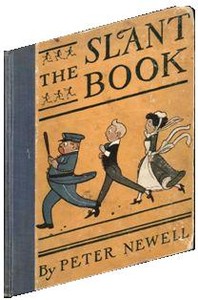
Read on Project GutenbergPeter Newell's The Slant Book (1910) is a physical novelty as much as a narrative: the original volume was printed and bound so that alternating pages tilt at a 15-degree incline or decline, forcing the reader to rotate the book to follow the text. This design choice directly mirrors the story's premise—a runaway go-cart careening down a steep hill with a delighted boy named Bobby at the helm. The verses, written in a jaunty, anapestic meter, describe a series of collisions with townspeople and objects, each encounter rendered with deadpan humor and precise, almost mechanical cause-and-effect. The book belongs to a tradition of early twentieth-century children's picture books that emphasized visual and tactile play, but Newell's integration of form and content is unusually thorough.
The Slanted Page as a Kinetic Device
The most distinctive feature of The Slant Book is its physical construction. As the catalog notes, alternating pages are set at a 15-degree angle, so that the text block itself appears to slide downhill. This is not merely decorative: the tilt forces the reader to physically adjust the book, mimicking the go-cart's descent. The opening couplet—"This uphill work is slow, indeed, / But down the slant—ah! note the speed!"—functions as a user's manual, instructing the reader in how to experience the book. The slant also disrupts conventional reading posture, making the act of reading a performance of the story's central motion. Newell, a noted illustrator and author of other shaped books like The Rocket Book, here treats the codex as a toy, a precursor to later pop-up and interactive formats.
Collision as Comic Structure
The narrative is essentially a chain of collisions, each stanza introducing a new victim and a new type of wreckage. The go-cart hits a policeman, a Greek push-cart vendor, a fire hydrant, a farmer's wife with eggs, a painter's ladder, a German band, a plate-glass window, an automobile, a sandwich-man, a boy with a hatbox, and a newsboy. The repetition of the crash pattern creates a rhythm of expectation and surprise. Newell varies the outcomes: the hydrant sprays water, the eggs become an omelette, the bass drum is pierced. Bobby himself remains untouched, even gaining a hat from one mishap. The violence is cartoonish and consequence-free, typical of early slapstick. The poem's meter—iambic tetrameter alternating with trimeter—keeps the action bouncing forward, each stanza a self-contained vignette.
Bobby's Detached Delight
Throughout the chaos, Bobby's emotional state is one of pure, unrepentant glee. He "laughed in high elation" as the nurse screams; he snipped a button from the policeman's coat as the officer sails overhead; after acquiring the hat, he declares, "Say, I'm the swellest kid in town!" The nurse's "hopeless consternation" and the adults' dismay contrast sharply with Bobby's delight. This tension between adult panic and childish glee is the book's emotional engine. Bobby is not a moral agent—he is a passenger, not a driver—yet he is never punished or remorseful. The story offers no lesson; it simply revels in the spectacle of disorder. This refusal to moralize is notable for a children's book of its era, aligning it more with the anarchic spirit of comic strips than with didactic children's literature.
Readers should approach The Slant Book as a physical object first: if possible, view a digitized version that preserves the angled pages, or imagine the tactile experience of tilting the book. The poem rewards reading aloud, with its rhythmic crashes and rhymes. Pay attention to the illustrations (not reproduced here) that Newell created to accompany each stanza, as they extend the visual comedy. The book is a snapshot of early twentieth-century urban life—policemen, pushcarts, German bands, sandwich-men—filtered through a lens of pure, amoral fun.
We keep The Slant Book on the low shelf, its tilted pages still whispering of that boy’s headlong joy. It reminds me of an older, quieter reckoning—how a landscape can tip a soul sideways, just as surely as a hill. That same pull lives in The Poems of Henry Kendall With Biographical Note by Bertram Stevens — Edition Insights, though his slope runs inward, toward dusk.
There are no reviews for this eBook.
Before you leave, reflect on the book
Use these questions to collect your thoughts before moving on.