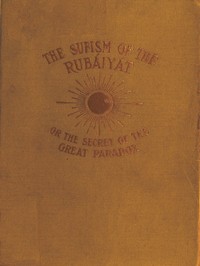
The Sufism of the Rubáiyát, or, the Secret of the Great Paradox — Edition Insights
Edition facts
This digital edition of The Sufism of the Rubáiyát, or, the Secret of the Great Paradox — Edition Insights is described by source-level measurements including 13,655 words, 1 hr estimated reading time, and 3 detected text sections.
The text analysis averages about 23.0 words per sentence, while the detected sections provide another way to judge how the source is divided.
Project Gutenberg metadata also associates the work with “Sufism,” connecting these edition facts with the source record’s subject description.
Read the complete public-domain text at its original source.
Read on Project GutenbergNorton F. W. Hazeldine’s The Sufism of the Rubáiyát presents itself not as a translation but as a revelation of the ‘higher and deeper truths’ concealed within Omar Khayyam’s quatrains. The preface immediately establishes a dual register: the author addresses readers as ‘thy brother man’ while claiming to unveil ‘the secret of the Great Paradox.’ Hazeldine’s notes systematically recast Persian figures—Rustam and Zál become ‘the universal positive and negative creative energies,’ and the Takht-i-Jamshyd is glossed as ‘the throne of wisdom, the mid-heaven.’ This interpretive framework transforms the Rubáiyát into a coded Sufi manual, where wine, the cup, and the tavern are read as metaphors for divine intoxication and spiritual discipline.
The Paradox as Method
Hazeldine announces his project as ‘a reading between the lines, a meaning, within a meaning, a paradox.’ This phrase, placed at the head of the notes, functions as the book’s hermeneutic key. The paradox is not merely a theme but a method: each quatrain is assumed to contain a surface meaning and a hidden spiritual sense. For example, the ‘Cup wrought out of gold’ is interpreted as ‘our collective experiences,’ and the line ‘having drunk that Wine of Wines’ is read as a reference to the soul’s return to its source. Hazeldine’s commentary consistently pushes the reader away from literal or hedonistic readings toward an allegorical understanding. The ‘Wine of Wines’ becomes the essence of divine love, and the act of drinking is transformed into a spiritual discipline. This approach aligns with classical Sufi ta’wil (esoteric interpretation), though Hazeldine does not use that term. Instead, he insists that the poet’s true meaning is accessible only to those who ‘read to learn of its sublime truths.’
Diction of the Divine and the Human
Hazeldine’s lexical choices reveal a consistent effort to sacralize the Rubáiyát’s imagery. The grape is not merely fruit but the vehicle of ‘the mysterious force within the grape, which renders possible fermentation, thereby changing its character from matter to spirit.’ This transformation is echoed in the commentary on stanza 31: ‘This life is the vine on which the grape doth grow, and fresh from its press the wine of life doth flow.’ The diction oscillates between the concrete (‘waste heap of sorrow,’ ‘pulp of wantonness’) and the abstract (‘deliverant pains of birth,’ ‘infinite law of heaven’). Hazeldine frequently employs imperatives (‘Beware! beware!!’) and rhetorical questions (‘Why was it put here if a curse?’) to create a prophetic tone. The voice is that of a teacher who has received direct illumination: ‘Thus was I taught of the love divine.’ This first-person claim to revealed knowledge distinguishes his commentary from scholarly analysis and positions it as a spiritual testimony.
Structure of the Commentary
The book is organized as a sequence of notes keyed to individual stanzas, but the commentary often expands into extended homilies. For instance, the note on stanza 30 moves from the ‘Cup wrought out of gold’ to a dialogue with the divine, in which the author asks why so many ‘spend their lives in tears’ and receives an answer: ‘All men and women were equal made! And of tears and sorrows gave he none to man; none can suffer except those who suffering choose.’ This passage, which runs for several paragraphs, is not a gloss on a specific line but a free-standing theological meditation. The structure thus alternates between close reading and expansive sermonizing. Hazeldine also includes moral warnings against ‘drink! fornication and other unlawful acts,’ which sit uneasily with the celebration of wine as a spiritual symbol. This tension between literal and allegorical readings is never fully resolved, and the reader must navigate between the two registers.
Recurring Images and Their Transformations
Several images recur throughout Hazeldine’s commentary, each undergoing a transformation from material to spiritual. The ‘grape’ becomes the ‘wine of life’; the ‘cup’ becomes ‘our collective experiences’; the ‘tavern’ becomes the ‘womb from whence all things are born.’ The figure of the ‘pateran’—a leaf placed at crossroads by travelers—is introduced as a symbol of guidance: ‘Sages the pateran have placed at every crossroad.’ This image, drawn from Persian travel custom, is used to explain why no one has returned from the spiritual path: ‘none have returned of that way here to tell! Which to discover, all for themselves must tread.’ The ‘tent’ of Omar Khayyam’s name is reinterpreted as ‘the Supreme Creator,’ because ‘a tent to their minds represented the universe.’ These transformations are not arbitrary but follow a consistent logic: every concrete object is a veil for a metaphysical reality. Hazeldine’s method is thus a systematic dematerialization of the Rubáiyát’s imagery.
Readers approaching The Sufism of the Rubáiyát should be prepared for a work that is part translation, part sermon, and part esoteric commentary. Hazeldine’s voice is that of a self-appointed revealer of secrets, and his interpretations often depart sharply from the literal sense of FitzGerald’s or other English versions. The book rewards those interested in early twentieth-century occult and Sufi revival movements, but it should not be mistaken for a scholarly edition. The best approach is to read it as a primary document of its era—a record of how one interpreter sought to uncover the ‘secret of the great paradox’ for a Western audience.
Some evenings, the way Hazeldine spoke of the wine as a hidden doorway to the divine stayed with me, quiet and warm. It made me recall a different kind of youthfulness, where discovery hung in every line. I found myself turning to Young Adventure: A Book of Poems — Inside the Classic; the same shimmer of asking beyond the surface felt like a familiar, old friend.
There are no reviews for this eBook.
What was your reading experience?
Capture what you thought, learned, and would like to remember.