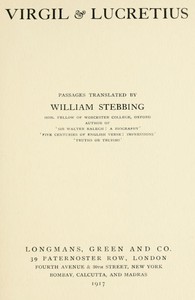
Virgil & Lucretius Passages translated by William Stebbing — Key Ideas to Explore

(0 User reviews)   426
Virgil, 71 BCE-20 BCE, Lucretius Carus, Titus, 95? BCE-50? BCE, Stebbing, W. (William), 1832-1926 [Translator] Project Gutenberg 2021 Not confirmed
Latin poetry -- Translations into English; Virgil -- Translations into English; Lucretius Carus, Titus -- Translations into English Readers of public-domain and historical texts
Project Gutenberg digital edition en

Edition facts

Words 28,708
Reading time 125 min
Text sections 24

Before opening Virgil & Lucretius Passages translated by William Stebbing — Key Ideas to Explore, the edition data offers a quick orientation: 28,708 words, 2 hr 5 min estimated reading time, and 24 detected text sections.

The text analysis averages about 24.0 words per sentence, while the detected sections provide another way to judge how the source is divided.

Project Gutenberg metadata also associates the work with “Latin poetry -- Translations into English,” connecting these edition facts with the source record’s subject description.

William Stebbing's 1917 translation of selected passages from Virgil and Lucretius, rendered in rhymed couplets. The excerpts show a translator who amplifies emotional intensity through dramatic pacing and sensory detail, notably in the Orpheus and Eurydice episode and the procession of Roman heroes in the underworld.
Share

Read the complete public-domain text at its original source.

Read on Project Gutenberg

William Stebbing's 1917 translation of Virgil and Lucretius selects passages that showcase his preference for dramatic, emotionally charged moments. The excerpts reveal a translator who does not merely render Latin verse into English but reshapes it with a distinctive rhythmic urgency. In the Orpheus and Eurydice episode, Stebbing compresses time with phrases like 'one short hour' and 'on the instant,' then stretches it with 'days, weeks, months, or years?'—a technique that mirrors the protagonist's fractured perception of grief. The narrative voice oscillates between swift, almost breathless action and lingering, sensory description, as when Orpheus keeps 'sad vigils by the moaning deep.' This editorial note examines how Stebbing manipulates pace and voice to create a translation that feels both immediate and reflective.

Rhythmic Urgency and the Compression of Time

Stebbing frequently accelerates narrative time to heighten emotional stakes. In the opening of 'Orpheus and Eurydice,' the wedding is dispatched in a single couplet: 'Orpheus had been espoused but one short hour, / And went to gather roses for the bower.' The serpent attack follows without pause, the bride's death occurring 'on the instant.' This compression contrasts with the drawn-out mourning that follows, where Orpheus 'from dawn to sunset, then until / The planets rose and sank' keeps vigil. The translator uses temporal markers—'one short hour,' 'on the instant,' 'days, weeks, months, or years'—to manipulate the reader's sense of duration, making grief feel both sudden and interminable. A similar technique appears in the 'Praise of Italy' passage, where the catalogue of Roman heroes is delivered in a rapid, almost breathless list: 'See, the grey-bearded King, the Priest, the Sage... Next, Tullus... then the proud Tarquins.' The pace mimics the procession itself, figures passing 'one by one' as if before the reader's eyes.

Sensory Detail and the Physicality of Despair

Stebbing's translation invests abstract emotions with physical weight. Orpheus's grief is rendered through bodily actions: 'kissing her closed eyes,' 'keeping sad vigils by the moaning deep,' 'thinking each shadow on the desert shore / Was his lost Bride.' The underworld is described as 'a darkness that might be felt, stark, and grim,' a phrase that emphasizes tactile sensation. In the Lucretius section, the 'Hymn to Venus' employs sensory contrasts—'Musical as is Apollo's Lute'—but the excerpts also show Stebbing's attention to the natural world's decay: 'Earth's Decay' is listed as a separate passage, suggesting a focus on physical processes. The translator's choice of verbs—'sprang,' 'trod,' 'woke,' 'fled'—gives the narrative a kinetic energy that grounds mythological events in tangible experience. Even the ghostly procession in Virgil's underworld is described with concrete details: 'forms pass, and then repass, / And straight are lost—reflections in a glass.'

Shifts in Narrative Voice: From Intimate to Epic

Stebbing modulates his narrative voice between intimate, almost colloquial tones and grand, epic pronouncements. In 'Orpheus and Eurydice,' the voice is close and personal: 'Not his alone the woe and misery; / Nor he sole mourner for Eurydice.' The use of 'alas!' and direct address ('Wilt, Son, in view of all thy future Rome') creates a sense of immediacy. By contrast, the 'Praise of Italy' section adopts a more formal, cataloguing style, with lines like 'See them to whom Achaia bows the head, / With Macedon's monarch in triumph led.' The translator also inserts parenthetical asides—'Whether Goddess, or Woman—a pale shape'—that momentarily break the epic frame, inviting the reader to question the nature of the apparition. This alternation between registers keeps the translation from settling into a single tone, reflecting the variety of the source texts themselves. Stebbing's voice is most distinctive when it blends the two, as in the line 'Rumours of his approaching overwhelm / Quaking Mæotis and the Caspian realm,' where the epic sweep is undercut by the almost journalistic 'Rumours.'

Stebbing's translations reward attention to the interplay of speed and stillness. Readers may find it useful to compare the pacing of the Orpheus narrative with the more stately processions in the Virgil selections, noting how the translator adjusts his line lengths and enjambments. The Lucretius passages, though fewer in the excerpts, appear to employ a more philosophical, measured tone—a contrast that underscores Stebbing's range. This edition offers a compact view of two major Latin poets through a single Victorian lens, inviting reflection on how translation choices shape our experience of classical texts.

Stebbing’s Orpheus, glancing back, loses Eurydice with such aching stillness that I found myself remembering the lonely horns of Roncevaux, where La Chanson de Roland : Translated from the Seventh Edition of Léon Gautier — Story, Setting & Ideas La Chanson de Roland : Translated from the Seventh Edition of Léon Gautier — Story, Setting & Ideas also mourns a hero’s final breath, each loss carried quietly by the weight of a single, unflinching line.

There are no reviews for this eBook.

0
0 out of 5 (0 User reviews )

Add a Review

Your Rating *
There are no comments for this eBook.

Reader reflection

Before you leave, reflect on the book

Use these questions to collect your thoughts before moving on.

Your progress 0 / 10
1

What is your current status with this title?

2

Did this book hold your interest?

3

How likely are you to recommend this book?

4

How much effort did this book require?

Related eBooks