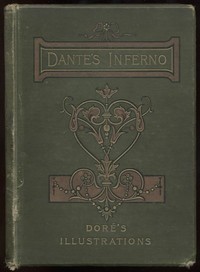
The Divine Comedy by Dante, Illustrated, Hell, Volume 06 — Background and Themes

(0 User reviews)   434
Dante Alighieri, 1265-1321, Cary, Henry Francis, 1772-1844 [Translator], Doré, Gustave, 1832-1883 [Illustrator] Project Gutenberg 2004 Not confirmed
Hell -- Poetry; Epic poetry, Italian -- Translations into English; Italian poetry -- To 1400 -- Translations into English Readers of public-domain and historical texts
Project Gutenberg digital edition en

Edition facts

Words 8,600
Reading time 38 min
Text sections 1

The catalog record for The Divine Comedy by Dante, Illustrated, Hell, Volume 06 — Background and Themes provides practical reading context through 8,600 words, 38 min estimated reading time, and 1 detected text section.

The text analysis averages about 25.1 words per sentence, while the detected sections provide another way to judge how the source is divided.

Project Gutenberg metadata also associates the work with “Hell -- Poetry,” connecting these edition facts with the source record’s subject description.

This volume of Dante's Inferno (Cantos 13–17) features the Wood of Suicides, the burning sands, and Geryon, with Doré's illustrations emphasizing the grotesque and the vast. The translation by Henry Francis Cary preserves the terza rima's rhythmic drive.
Share

Read the complete public-domain text at its original source.

Read on Project Gutenberg

This sixth volume of Henry Francis Cary's translation of Dante's Inferno covers Cantos 13 through 17, a sequence that moves from the violent against themselves to the violent against God, nature, and art, and culminates in the descent to the eighth circle on the back of Geryon. The excerpts show a marked shift in landscape: from the twisted, thorny forest of the suicides—where broken branches bleed and speak—to the open plain of burning sand under a rain of fire, and finally to the precipice where the fraudulent monster Geryon rises from the abyss. Gustave Doré's illustrations, though not reproduced in this text, are referenced in the title and likely informed the visual imagination of early readers. Cary's blank-verse translation, first published in 1814, aims for a dignified English idiom while retaining the vivid, often grotesque physicality of Dante's original.

The Speaking Wood and the Punishment of Suicides

Canto 13 presents one of the most memorable punishments in the Inferno: the suicides are transformed into gnarled, thorny trees that bleed and speak when broken. Dante plucks a twig from a wilding, and the trunk cries out, “Why pluck'st thou me?”—a moment that collapses the boundary between vegetable and human. The description of the forest is deliberately repellent: the foliage is “not verdant” but “of dusky hue,” the boughs “with knares deform'd,” and the fruits are “thorns with venom fill'd.” This is not a natural wood but a deliberate inversion of fertility. The Harpies nest here, wailing from the branches. Virgil explains that these souls will never be reunited with their bodies at the Last Judgment; instead, their bodies will hang from the trees. The episode also introduces Pier della Vigna, the minister of Frederick II, who tells his story of unjust accusation and suicide. His speech is elaborate and courtly, contrasting with the brutal physicality of his punishment.

The Burning Sands and the Blasphemers

Canto 14 opens onto the third round of the seventh circle: a plain of scorching sand where three classes of sinners lie, sit, or wander under a rain of fire. The text describes the sand as “burning marle,” and the flakes of fire fall like snow on an Alpine peak. Among the blasphemers is Capaneus, one of the Seven against Thebes, who lies supine and defiant, shouting curses at God. Virgil rebukes him, saying his pride is his own torment. The canto also includes a digression on the rivers of Hell: the Acheron, Styx, Phlegethon, and Lethe, which Virgil explains flow from the tears of a great statue of Time. This mythological excursus provides a structural pause before the action resumes. The landscape here is stark and monotonous, a flat expanse of heat and pain, with no shade or relief. Dante's focus on the physical sensations—the burning sand, the falling fire—makes the punishment viscerally immediate.

The Violent Against Nature and the Wood of the Sodomites

Canto 15 and 16 treat the sodomites, who run in ceaseless motion under the rain of fire. In Canto 15, Dante meets his beloved teacher Brunetto Latini, who walks with him along the edge of the burning sand. Their conversation is poignant: Brunetto predicts Dante's future exile and praises his work. The canto is notable for its shift in tone—from horror to affectionate respect—as Dante expresses gratitude for Brunetto's teaching. The sodomites are divided into three groups that run in opposite directions, crossing paths like runners in a race. In Canto 16, three Florentine nobles approach Dante, asking for news of their city. Their speech is urgent and their movements swift; they break their circle and flee “as pinions seem'd their nimble feet.” The canto ends with the sound of rushing water, the Acquacheta river, which heralds the approach of the abyss. The contrast between the static trees of Canto 13 and the frantic running here underscores the variety of punishments within the same circle.

Geryon and the Descent into Fraud

Canto 17 introduces Geryon, the monster of fraud, who will carry Dante and Virgil down to the eighth circle. The description is elaborate: his face is that of a just man, but his body is serpentine, with two shaggy claws and a tail tipped with a scorpion's sting. His back is painted with “nodes and orbits” in colors more varied than Turkish or Tartar cloth. He sits on the edge of the abyss like a beaver watching for prey. Dante and Virgil approach him, and Virgil speaks to him while Dante examines the usurers on the burning sand below. The usurers sit in a crouched position, their eyes fixed on purses emblazoned with their family crests. The canto ends with Dante and Virgil mounting Geryon's back and descending into the void. The descent is described with a simile of a swimmer loosing an anchor, and Dante's fear is palpable. This canto marks a transition from the relatively straightforward punishments of violence to the more complex and deceptive sins of fraud.

Readers approaching this volume will find that the structure of the Inferno rewards attention to transitions: each canto shifts not only in location but in the quality of suffering and the moral logic behind it. The movement from the silent, bleeding trees to the running sodomites to the stationary usurers and the flying monster Geryon creates a rhythm of stasis and motion that mirrors the spiritual states of the damned. Cary's translation, while occasionally archaic, preserves the clarity of Dante's visual imagination. The Doré illustrations, though absent from this text, are worth seeking out for their dramatic interpretation of these scenes.

That gray afternoon, the rain against the window softened Doré’s terrible hellscape into something almost lulling. I lingered on the suicides’ bleeding trees, their wasted voices, and felt a strange, quiet melancholy. Later, rifling through a stack, I found Civil service jingles and other things — Text and Context, and its off-kilter rhymes carried the same odd, sorrowful rhythm, just of another world entirely.

There are no reviews for this eBook.

0
0 out of 5 (0 User reviews )

Add a Review

Your Rating *
There are no comments for this eBook.

Reader reflection

Take a moment to reflect on this book

Create a short personal record of your experience with this book.

Your progress 0 / 10
1

What is your current status with this title?

2

Was reading this book enjoyable?

3

Would you encourage someone else to read it?

4

How much effort did this book require?

Related eBooks