The hermit thrush — Reading Companion
Edition facts
The hermit thrush — Reading Companion can be approached with a clearer sense of reading commitment from its source measurements: 3,511 words, 16 min estimated reading time, and 1 detected text section.
The text analysis averages about 27.9 words per sentence, while the detected sections provide another way to judge how the source is divided.
Project Gutenberg metadata also associates the work with “American poetry -- 19th century,” connecting these edition facts with the source record’s subject description.
Read the complete public-domain text at its original source.
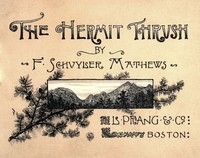
Read on Project GutenbergF. Schuyler Mathews's The Hermit Thrush (1896) is a narrative poem that traces the song and setting of its avian subject through the New Hampshire landscape. The poem opens with a description of spring air and blue hills rising above a belt of spruce and pine, establishing a precise geographical frame. The thrush is introduced as a hermit who is “brown, and small in size” and who “hides away from curious eyes,” yet its song is described as possessing a “wealth of melody sweet” that surpasses any organ or musician. The poem moves from the thrush’s perch in a tall tree to a leaning birch beside a mill, where the mill’s “broken buckets” beat time to the thrush’s song. Later stanzas name specific peaks—Kinsman’s dome and Lafayette’s pyramid—and the Pemigewasset River, grounding the bird’s song in a real, named place.
Catalog Subjects vs. Poetic Content
The Project Gutenberg record lists this work under “American poetry – 19th century,” “New Hampshire – Poetry,” and “Hermit thrush – Poetry.” These categories are accurate but incomplete. The poem is indeed about a hermit thrush in New Hampshire, but it does more than describe the bird: it personifies the thrush as a recluse who “wears no cowl and studies no book,” blending monastic imagery with natural history. The catalog subjects do not capture the poem’s narrative structure—the thrush is introduced as a character with a backstory (“he retired from its youthful folly”) and a setting that includes a mill with a “shaky, clumsy wheel.” The poem also includes a direct address to the reader (“Should you wish to hear this hermit thrush sing”), which turns the description into an invitation. The subjects thus underrepresent the work’s blend of natural observation, personification, and local geography.
Sound and Structure in the Excerpts
The poem’s meter is consistent iambic tetrameter with rhyming couplets, creating a steady, songlike rhythm that mirrors the thrush’s own melody. For example, the lines “The sweet fresh air of the new springtime / Breathes o’er the woods where the blue hills climb” establish a regular beat. The poem also uses sound effects: the mill “Frets and fusses and sputters away, / And beats the water to foam and spray,” with alliteration and onomatopoeia. The thrush’s song is described as having “a touch of melancholy / In cadence soft,” and the poem itself shifts from cheerful description to a more reflective tone. The structure is linear: it moves from the thrush’s general habitat to specific locations (the mill, the mountains) and ends with an invitation to visit the “blue notch mountains.” The excerpts do not include a conclusion, so the poem’s full arc is unknown, but the existing stanzas show a clear progression from introduction to specific scene-setting.
Landscape as Character
The New Hampshire landscape is not merely a backdrop but an active presence in the poem. The hills “climb,” the pines “hide” the hills’ feet, and the birch trees “nod and bend.” The mill is personified as “worn out with the work of grinding meal,” and its wheel beats time to the thrush’s song. The poem names specific geographical features: Kinsman’s dome, Lafayette’s pyramid peak, and the Pemigewasset River. These references ground the poem in a real, recognizable place, likely the White Mountains region. The thrush is described as living “on the edge of the wood where the white birch trees” stand, and its song is heard “in the gloaming still” beside the mill. The landscape is thus integral to the thrush’s identity—the bird is defined by its habitat. The excerpts do not reveal whether the poem includes any human characters beyond the implied observer, but the landscape itself is given agency and personality.
Readers approaching The Hermit Thrush should attend to how Mathews uses meter and rhyme to evoke the bird’s song, and how he weaves specific place names into a poetic geography. The poem rewards attention to its sound patterns and its personification of both bird and landscape. Because the excerpts are incomplete, the full narrative arc—if any—remains unknown, but the existing stanzas offer a self-contained portrait of a thrush in its environment.
Sometimes a voice from a past century stays with you—like the thrush’s song echoing off those New Hampshire hills, quiet and unhurried. I found a similar patience in Civil service jingles and other things — Text and Context, where everyday rhythms turn gentle and reflective. It lingered the way a familiar trail does, without asking anything of you.
There are no reviews for this eBook.
Record your reading impressions
A brief reflection can help important ideas stay with you longer.